Ephemeral Test Environments for API-Dependent Services in CI
Stateful API simulators let ephemeral test environments avoid live service dependencies.
An ephemeral environment is a temporary, isolated copy of an application stack, created when a pull request opens, used for a bounded stretch of time, and destroyed automatically afterward. It solves a specific problem that shared staging environments cannot: test-against-test interference, configuration drift, and false failures that appear when another team's change lands in the middle of a run.
Shared staging has always carried a structural flaw. Ephemeral environments remove two of those three explanations by construction. Each one gives a single pull request its own full-stack copy of the application, with the same services, APIs, configurations, and dependencies as production, scaled down but not simplified away. It stays isolated from every other environment running in parallel, its lifecycle is handled through automated provisioning and teardown, and it is short-lived by design.
The lifecycle is the same across most implementations that use this pattern. A developer opens a PR. CI builds the service, runs unit tests, and provisions a dedicated environment for that PR alone. Results post back to the PR as annotations, and the merge button stays locked until every check turns green. When the PR merges or closes, the environment is torn down, and whatever state it accumulated disappears with it.
Infrastructure-as-code tools make this practical at scale. The cost model follows directly from that same property. Nothing sits idle waiting for the next test cycle. Cloud spend tracks actual usage rather than a fleet of staging boxes kept warm around the clock. That cost discipline, and the isolation it rides on, is also what replaces the older bottleneck of teams queuing for a single shared staging slot, filing tickets to get access, and working around data another team already modified.
That is the full promise of the model: isolation, parity with production, and a clean teardown. It holds up well for the parts of the stack a team fully controls. It gets considerably harder to sustain the moment the application under test needs to talk to something outside that boundary.
Why third-party API dependencies break the ephemeral model
An ephemeral environment that makes live calls to a third-party API is not actually isolated, no matter how cleanly its infrastructure was provisioned.
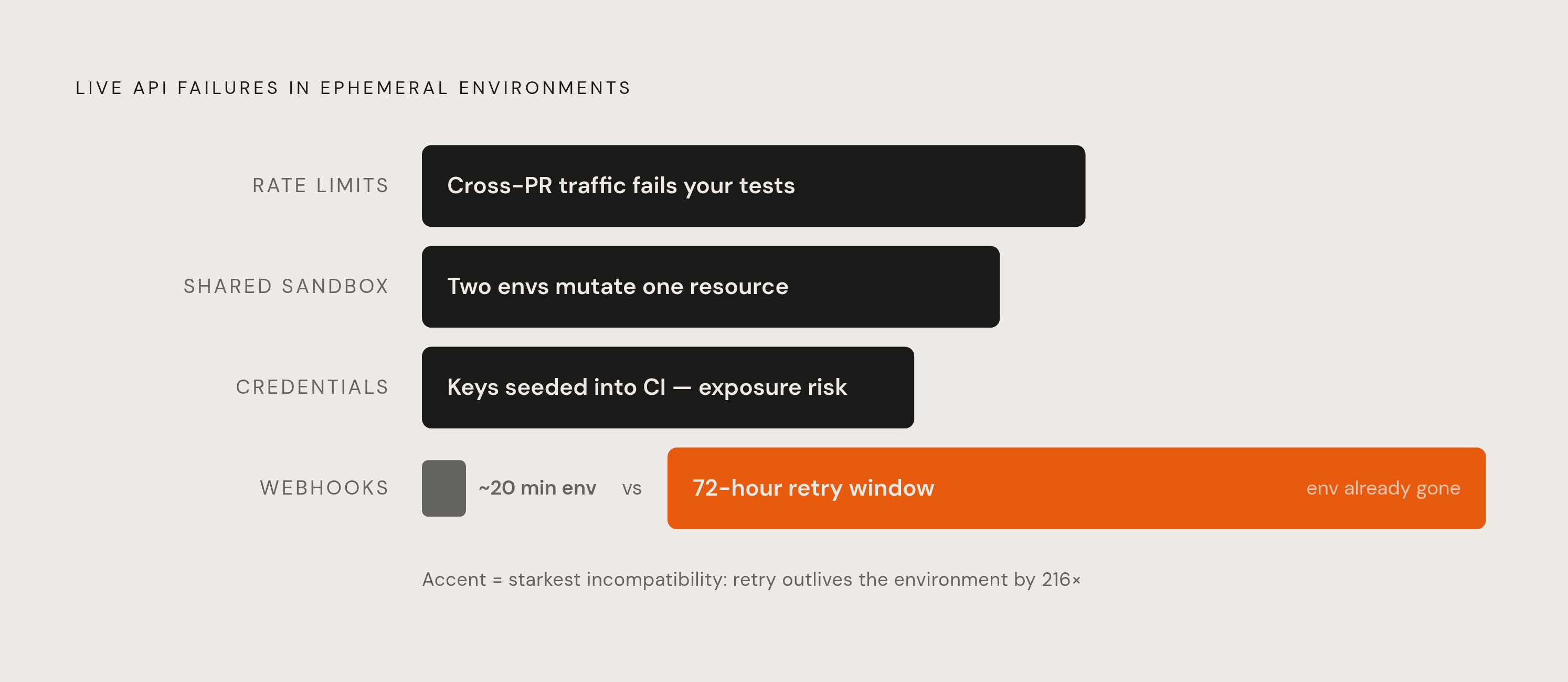
Rate limits are the most immediate symptom. The test fails, the developer assumes a regression, and the actual cause is traffic volume from an entirely different pull request.
Shared sandbox state causes a quieter version of the same problem. The infrastructure layer looks isolated. At the data layer, the two environments are sharing a single mutable resource, which is the exact condition ephemeral environments are built to avoid.
Credentials add a separate security risk. Every environment that calls a live API needs to be seeded with a key or token, and that credential has to live somewhere in CI, whether in a secrets vault, an environment variable, or a config file. Mishandling it, whether through a misconfigured log line or a committed file, is a direct security exposure, independent of how tightly scoped the rest of the environment is.
Webhooks introduce a timing problem that cannot be engineered around from inside a short-lived environment. Undelivered events get retried for up to three days. An ephemeral environment that lives for twenty minutes has no way to wait around for a retry that might not arrive for seventy-two hours. Any test relying on webhook delivery timing is, by construction, testing against a process that outlives the environment itself.
Vendor sandbox tooling has its own fidelity limits here, and they are not a criticism of the vendors, just a mismatch of scale. Stripe's own guidance recommends separate sandboxes for local development and CI, and dedicated sandboxes per team or testing scenario where stronger isolation matters. Provisioning a fresh vendor sandbox for every PR is not something most teams can do.
Strip all of this down to one sentence: a live third-party API is a shared, mutable resource governed by someone outside the team's own infrastructure. That is the opposite of what an ephemeral environment is supposed to provide.
Why stateless mocks don't close the gap
The obvious fix is to stop calling the live API at all and swap in a mock. That removes the rate-limit problem and the credential problem in one move, but it trades them for a different one: a mock proves that a request was shaped correctly, not that the service behind it would have actually worked.
A stateless mock is a simple thing by design. It maps an incoming request pattern to a pre-configured response: see a GET on this path, return that body. It has no memory of any call that came before it. That's fine for a single request-response check. It falls apart the moment a test needs to verify a sequence of actions that depend on each other.
Picture a common payment workflow test. What it does not catch is that the handler never actually stored the PaymentIntent ID from the first call, so the second step in the real webhook path reads an undefined value. That bug ships, merges, and shows up for the first time when a real customer runs through checkout in staging.
A stub returning the same order on every call to GET /orders/42 cannot express a flow where state changes over time: create an order, fetch it, cancel it, fetch it again, and see a different status on that second fetch. That lifecycle is what the mock has no way to represent, because representing it would require the mock to remember something about the first call when it answers the second.
The instinct to patch this by writing more mocks runs into its own ceiling quickly. Worse, those mocks can drift silently from what the real API actually does, since nothing forces them to stay synchronized with the vendor's current behavior.
What's actually needed is something that holds state the way the real API does: a simulator that can run locally inside the ephemeral environment, needs no live credentials, and behaves consistently across a sequence of calls.
What a stateful, locally hosted simulator provides
A stateful simulator hosted inside the ephemeral environment gives each pull request its own self-contained API layer. It remembers what happened across calls, needs no live credentials to run, and gets torn down along with the rest of the environment when the PR closes.
The mechanism is straightforward to describe and does the heavy lifting. POST a resource to the simulator and it gets stored. A PATCH call updates it, and a state machine inside the simulator enforces which transitions are actually valid, the same way the real API would reject an invalid state change. All of this runs locally. The lifecycle semantics of the real API are preserved without a single call leaving the environment.
Statefulness is the single property that restores the ephemeral model. The API layer now sits inside the environment boundary. There is no sandbox shared across PR environments, no rate limit shared across an API key, and no credential that needs to be vaulted, scoped, or rotated for yet another environment.
Pre-seeding the simulator with realistic data matters more than it might first appear. A simulator that ships with realistic fixtures already loaded lets a test start from a meaningful state and spend its time exercising the transition being tested, not rebuilding the scaffolding around it.
Webhooks stop being an unpredictable dependency once the simulator owns the timeline. It can fire events on state transitions in a predictable, scripted order, entirely within the lifespan of the environment, which removes the retry delays and ordering uncertainty that come with live webhook delivery.
None of this is a claim that a simulator replicates everything about a live API, and it would be dishonest to present it that way. What it validates well is integration patterns and lifecycle correctness, the sequences of create, read, update, and cancel that make up most of what application code actually depends on. Vendor-specific edge cases still need their own, narrower testing elsewhere.
Wiring a stateful simulator into an ephemeral environment pipeline
The full architecture replaces every outbound call to a third-party API with a call to a locally hosted simulator. That simulator starts when the environment starts, runs inside the same network namespace as the application under test, and gets destroyed when the environment does. Nothing in the critical path depends on a service outside the environment's own boundary.
Provisioning follows one of two patterns, depending on what the team already runs. Either way, the simulator comes up and goes down on the same schedule as the environment it belongs to.
Pointing the application at the simulator instead of the live API is a configuration change, not a code change. Most applications already read their API base URL from an environment variable. The application code that makes the API calls doesn't need to know the difference.
Secrets management gets simpler as a direct result. That shrinks the surface area of secrets that need to be stored, scoped, and rotated, and it removes one more place where a leaked credential could cause damage.
Test isolation still matters inside a single environment, even after shared state across environments is resolved. For workflows with real state dependencies across multiple steps, running those tests in serial mode against an isolated data context is more reliable than letting parallel test workers share the simulator's global state and step on each other.
The goal for feedback speed is minutes. Sharding the test suite across parallel workers, caching dependencies between runs, and reserving full regression suites for the main branch and nightly builds rather than running them on every single push keeps the per-PR loop fast enough that it doesn't become a bottleneck of its own.
Teardown is the simplest part of the whole design. Because the simulator's data lives only as long as the environment does, there's no remote state to clean up when a PR closes. The stack gets destroyed, and whatever the simulator was holding goes with it.
Fault injection as a first-class concern in ephemeral API testing
A stateful simulator inside the ephemeral environment is the only place where a team can inject faults, latency, 429s, 503s, partial failures, deterministically and without risk to anyone else. That turns resilience testing into something that runs on every PR instead of something reserved for an occasional chaos-engineering exercise.
Neither of the two prior approaches can do this safely. A live API shared across environments cannot be made to fail on demand for one PR's test run without also affecting every other environment pointed at that same sandbox. Testing a retry path requires exactly that kind of sequence, and a stateless mock simply cannot express it.
A stateful simulator can be scripted to produce that exact sequence on command, which makes it possible to verify that an application's retry logic, including exponential backoff, its circuit breakers, and the error messages a user actually sees all behave correctly under conditions that would be unsafe or impossible to produce against a real vendor endpoint.
The practical approach is to start small and build up. Because the ephemeral environment is isolated from every other environment running in parallel, a test that deliberately breaks the integration on purpose cannot leak that failure into anyone else's PR.
Fault-injection tests belong in the same PR-level suite as the functional tests, not set aside as a separate, occasional exercise. If the retry path is broken, that is a merge-blocking failure the same way a broken endpoint is, and the merge button should stay red until it's fixed.
Testing AI agents that call external APIs in ephemeral environments
AI agents and MCP servers are now one of the fastest-growing sources of API traffic hitting these pipelines, and they are structurally more sensitive to a simulator's fidelity and state correctness than ordinary application code. They also open up attack surfaces that make isolated, ephemeral testing more important, not less.
Agents use the responses they get back differently than humans do. A small amount of contract drift that a human looking at a UI might not even notice can cause an agent to take the wrong downstream action without any visible error at all, because nothing in the interaction required a human to notice.
A separate problem sits on top: an agent can produce perfectly coherent, readable text while sending malformed JSON to a payment API underneath it. Testing has to check parameter extraction, endpoint selection, and response parsing directly, because the fact that the agent's output reads fine to a person says nothing about whether the request it sent was valid.
The security stakes are higher too. Prompt injection that pushes an agent into making an unauthorized API call, pulling out data it shouldn't, or modifying a record it had no business touching, creates compliance and liability exposure that sampling production traffic after deployment cannot catch after the fact. These failure modes need to be caught inside the ephemeral environment, before the change merges, not discovered later in an audit.
This is exactly where a stateless mock runs out of road for agent testing specifically. An agent workflow that creates a record, reads it back, and then acts on what it finds cannot be tested against a mock with no memory of the first call. The simulator has to hold the state that the agent's second and third calls depend on, the same requirement that applies to ordinary application code, just with less room for silent failure once an agent is the one making the decisions.