GitHub Actions Workflow for Stripe Integration Testing
Stateful lifecycle tests catch Stripe integration bugs that mocks miss.
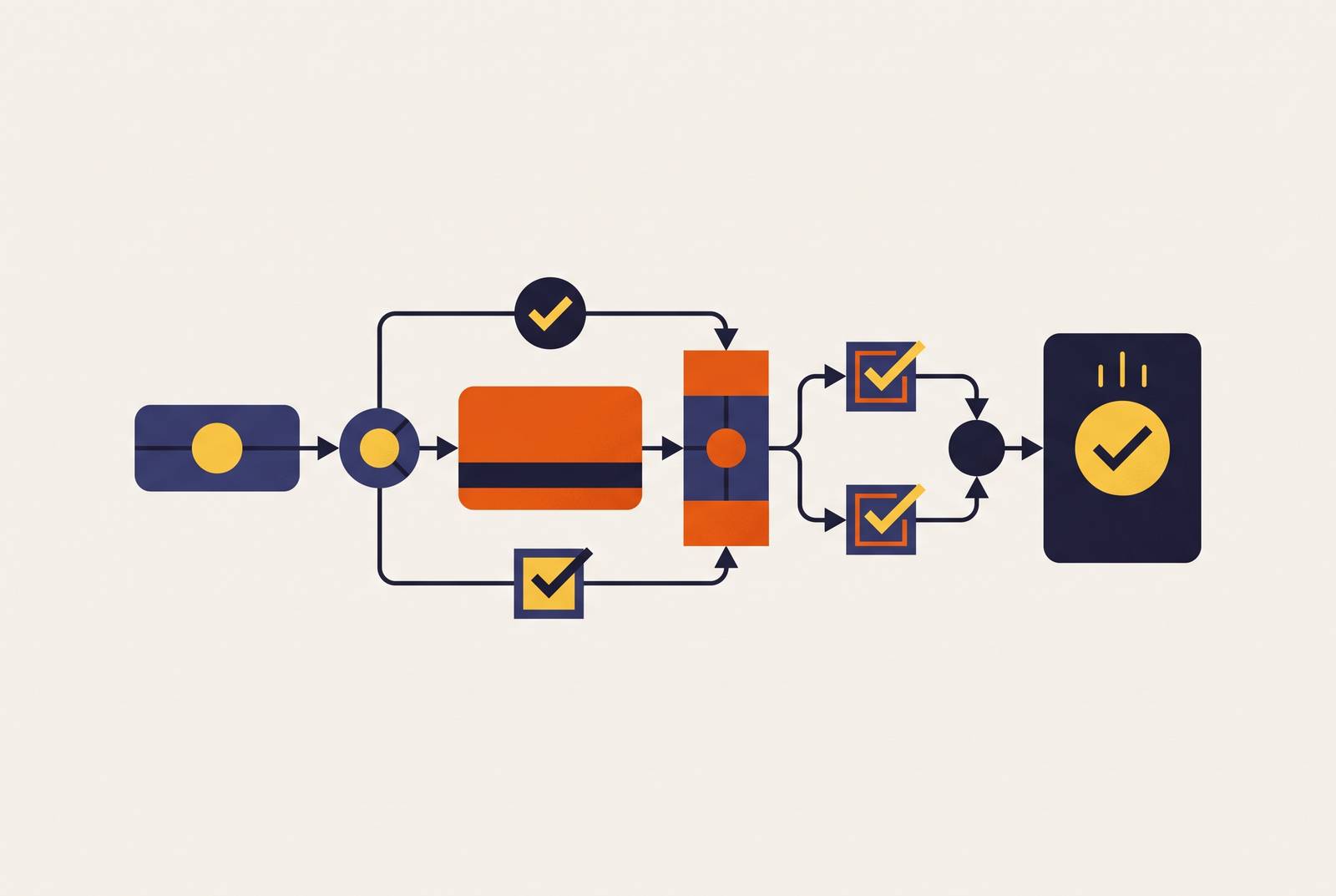
The most common Stripe failure in continuous integration is a test that passes while a lifecycle bug hides underneath it: the pipeline goes green, the pull request merges, and production breaks at step two of the payment flow. One account of this failure lays out the pattern. The CI pipeline mocked POST /v1/payment_intents and asserted a 200 response. The merge button lit up. The first real checkout in staging then failed, because the handler never stored the PaymentIntent ID, and step two of the webhook path read undefined when it tried to look that ID up. The mock had confirmed that the request JSON looked right. It had no way to confirm that step two could actually read the ID step one generated, because that is a lifecycle question, not a shape question. Coding agents now scaffold Stripe integrations and ship them into review faster than a human reviewer can check each call by hand, and the mock keeps passing after every edit the agent makes, whether or not the edit broke the flow underneath it.
Why stateless mocks structurally cannot catch lifecycle bugs
A stateless mock returns a fixed response to every matching request, and it keeps no memory of what came before it. Whatever consistency it shows across a test run comes from how someone configured it, not from any resemblance to how the real API behaves across a sequence of calls. The mock server has no record of the previous request, so it cannot tell you whether the customer created in step one still exists by the time step three checks for it. That is a structural limit, not a configuration mistake, and it sets a clear boundary on where stateless mocks belong: they work well for checking that an isolated REST endpoint returns the right shape and the right error codes, but they are the wrong tool the moment a later step depends on an exact ID or a state change that an earlier step produced. For Stripe specifically, a stateless mock cannot carry state across requests, cannot enforce Stripe's own state transitions (a PaymentIntent moving from requires_confirmation to requires_capture), cannot fire a webhook event when a real state change happens, and cannot hand a later step an ID that step actually needs to retrieve.
The usual defense says the team writes its mocks carefully and the tests pass, but that misses what a passing test actually proves. A mock test can pass, but that only proves the mock contract held, not the real Stripe API contract. The mock drifts from Stripe's actual behavior every time Stripe updates its API, and nothing in a stateless test setup will flag that drift. Most teams find out in production, not in CI. This is also why mocking on its own cannot stand in for contract testing: a mock can quietly diverge from the real API's behavior, hand-written stubs need a manual update for every real API change, and that update rarely happens on schedule.
What a stateful Stripe test sequence verifies
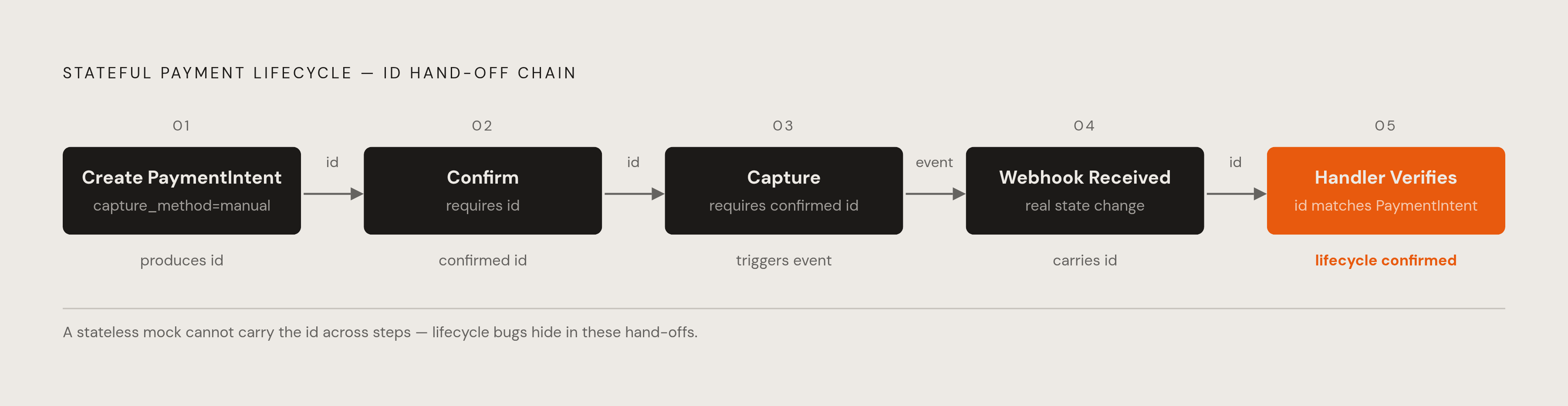
A real Stripe integration test does not just ask whether a single POST returns 200 once. Each step in that sequence has to read the state the step before it wrote. The minimum version of that sequence for a payment flow runs through five linked stages: create a PaymentIntent with capture_method set to manual, confirm it, capture it, receive the webhook event that fires because the state actually changed, and verify that the webhook handler read back the correct ID from that same PaymentIntent. Each stage depends on the one before it. The confirm step needs the id that the create step returned. The capture step needs the id that confirm produced. The webhook handler needs to look up a record that was genuinely stored somewhere, not a hardcoded fixture standing in for one. The CI pipeline in the staging failure above never ran the webhook branch, because its mock never triggered the kind of state change that would cause a webhook to fire. Refund flows, dispute flows, and subscription renewal flows all follow this same shape: each one is a lifecycle made of dependent steps, not a single endpoint to be checked in isolation. The right way to structure this in CI keeps the two kinds of test separate: stateless tests stay fast and run in parallel to check shape and error modes, while stateful lifecycle tests run in isolated, serial mode with their own cleanup step afterward. Stateless by default, stateful by design.
Structuring the GitHub Actions workflow file for Stripe lifecycle testing
If you build a GitHub Actions workflow for Stripe testing, gate deployment on proof that the full payment lifecycle passed as one connected sequence, not on isolated unit assertions that never talk to each other. The standard pipeline order for 2026 runs quality checks, then unit tests, then integration tests, then the build, then deployment restricted to the main branch. So the Stripe lifecycle step belongs in the integration tier, after unit tests pass but before the build starts.
That lifecycle step should resolve to a simple pass or fail. Exit code 0 means every stage in the lifecycle, create, confirm, capture, webhook, passed, and the merge is allowed to go through. If a named stage fails, such as create_payment_intent or the webhook reconcile step, the exit code is 1 and the PR gets blocked until that's fixed. None of this needs a staging environment, an IP whitelist, or live credentials sitting in CI environment variables. The Stripe test key should never be hardcoded into the workflow file. Store it as a GitHub repository secret and reference it as ${{ secrets.STRIPE_TEST_API_KEY }}, which is the standard way GitHub Actions handles sensitive credentials.
Webhook testing deserves particular care, because the most common failure here has nothing to do with Stripe and everything to do with how web frameworks handle request bodies. Express and similar frameworks auto-parse incoming request bodies into JSON by default. Stripe's HMAC signature verification needs the raw, unparsed bytes of that body to check the signature correctly. If a global body-parser middleware runs ahead of the webhook route, signature validation breaks in production, because unit tests rarely exercise the raw-body path, so every unit test in the suite can still pass.
The Stripe CLI gives you two ways to generate real events inside the workflow. stripe listen --forward-to opens a direct connection to Stripe and forwards real test-mode webhook events tied to the account behind the given API key. [stripe trigger](https://docs.stripe.com/payments/payment-intents/verifying-status) payment_intent.succeeded is built from fixture data embedded in the CLI itself: generic test objects created on the fly, pulled from the account's actual data. One known trap for CI runners: interactive login through stripe login --interactive fails inside a GitHub Actions runner with an "inappropriate ioctl for device" error, since there's no terminal to interact with. So you should use the non-interactive flag, or authenticate through an environment variable instead.
For parallelism, you can run the stateless unit tests across parallel matrix jobs, since they're fast and don't depend on each other. Run the stateful Stripe lifecycle job as a single serial job, with needs: [unit-tests] set so it only kicks off once the fast tier has already passed.
Injecting Stripe fault scenarios to test resilience in the same workflow
If a stateful simulator can switch between fault scenarios without any code change, the same CI job can check for more than just whether a payment succeeds. It can check whether the integration handles Stripe's realistic failure conditions the way it should. Six fault scenarios cover most of what matters for a Stripe integration: a payment declined with realistic error codes, insufficient funds returned as a 402 with a card_error and an insufficient_funds decline code, rate limiting returned as a 429 with Stripe-Rate-Limited-Reason headers attached, auth failure from an invalid API key or missing permissions, a simulated 3D Secure authentication challenge for SCA, and a dispute or chargeback resolution flow.
These scenarios carry real weight, because a system that responds to a 429 by crashing, or by retrying without any backoff, ends up amplifying load on Stripe's own servers in production. The CI job should check that the retry and circuit-breaker behavior is correct, with the happy-path 200 response alone not being sufficient. Chaos engineering offers a useful structure for this kind of check: start with a defined hypothesis, for example that when Stripe returns a 429, the handler retries with exponential backoff and never re-charges the customer, attach a measurable outcome to that hypothesis, and fail the pipeline if the resilience behavior crosses the threshold set for it. So fault injection belongs in the same integration tier as the lifecycle test, not off in a separate manual process that someone runs by hand before a release. Once a system passes a given fault scenario in CI, that scenario should stay in place as an automated regression check on every PR that follows.
Applying the same stateful workflow approach when an AI agent writes the Stripe integration
When a coding agent edits Stripe integration code, the stateful CI workflow already described is the only automated check that can catch what the agent actually broke in the payment lifecycle, because the stateless mock keeps passing after every edit no matter what changed underneath it. Agents produce code and explanations that read as coherent, but coherent output and correct behavior are not the same thing. An agent can call the wrong endpoint, forget to store the PaymentIntent ID, or generate malformed JSON for a payment API, and the output can still look clean on review. Standard evaluation metrics for agent output miss these failures, because they measure isolated outputs, not the full sequence of decisions an agent made across a multi-step task.
The practical response is to run the Stripe lifecycle proof locally, through an MCP connection, before the agent ever opens a pull request. That local run gives the agent something closer to a receipt: a sandbox timeline, the pass or fail status of each step, and real provider-shaped IDs generated during the run. CI then runs the same workflow in its headless version as the merge gate, so what the agent proved locally can't quietly regress in its next session. FetchSandbox MCP connects to Cursor, Claude Code, Cline, Windsurf, and Codex through the same npx command, with each IDE keeping its own config file location and format, which puts the same stateful Stripe simulator that runs in CI directly into the agent's tool loop before a PR ever reaches a human reviewer. What the CI job needs to check for agent-generated integrations comes down to three things: whether parameters were extracted correctly, whether the right endpoint was selected, and whether the response was parsed correctly. These are exactly the errors agents tend to introduce, and a stateless mock assertion will let every one of them through without complaint.
What continuous simulator verification catches beyond the CI workflow
A stateful simulator that is never checked against the live Stripe API will drift from it quietly over time, which brings back the same false-confidence problem this entire workflow was built to solve, just further down the road. Drift is the enemy both mocks and simulators share. Mocks drift faster, because someone has to maintain them by hand, and every change Stripe makes to its API becomes a manual stub update that most teams only discover once it breaks in production.
The distinction that matters here is where the simulator's accuracy comes from. Where an API specification exists and stays current, generating the simulator from that spec is the better path, because the simulator then inherits the spec's accuracy automatically instead of depending on someone remembering to update it by hand. Hand-defined stubs still have a place, but only where precise control over edge cases the spec cannot express is genuinely needed. A workflow built on create, confirm, capture, and webhook as a connected sequence keeps each step honest about the state the step before it produced. That workflow still tells the truth six months from now only if you keep checking the simulator underneath it against Stripe's actual behavior, not just against itself.