Offline CI Pipelines for Air-Gapped Enterprise Environments
Five infrastructure layers swap easily; the sixth—third-party APIs—demands stateful simulators.
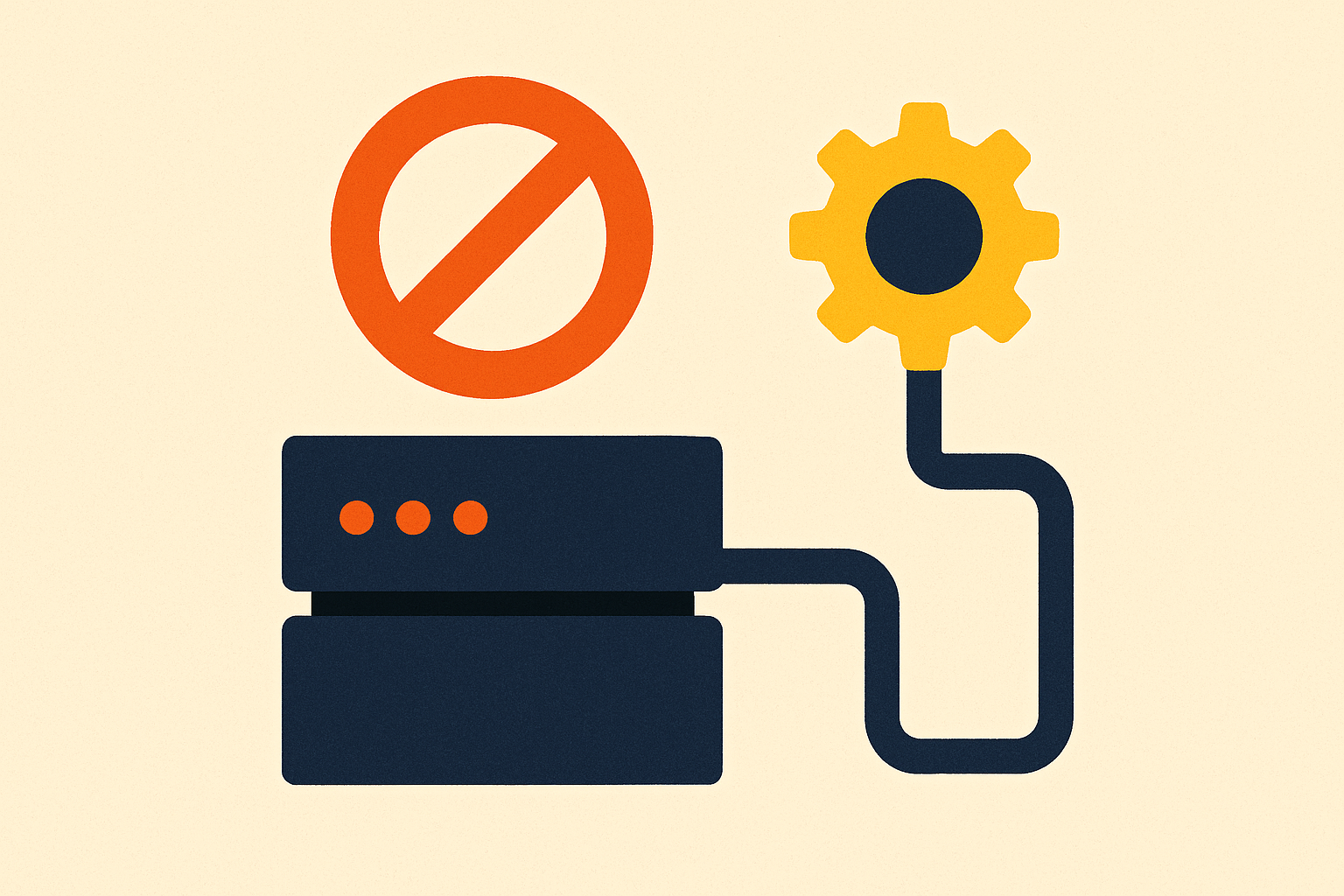
A defense contractor or financial institution can spend months building an air-gapped CI pipeline, get the source control right, the build servers right, the artifact storage right, and still discover in the final week before deployment that its payment flow or its Slack notification step has no way to run in isolation. Late discovery is the predictable result of treating network isolation as a checklist of infrastructure swaps rather than a different engineering discipline altogether. Defense contractors, financial institutions, critical infrastructure operators, and research environments treat air-gapping as a baseline security requirement, not an edge case, and the pipelines they build have to behave as though the internet does not exist from the first command to the last. Third-party API integration, the code paths where an application calls Stripe, Slack, GitHub, PayPal, or similar services, gets deferred longest because it looks like a test concern rather than an infrastructure concern, and because it is easy to assume a live sandbox will work until the day it doesn't.
The six infrastructure layers every offline pipeline must replace before a single build runs
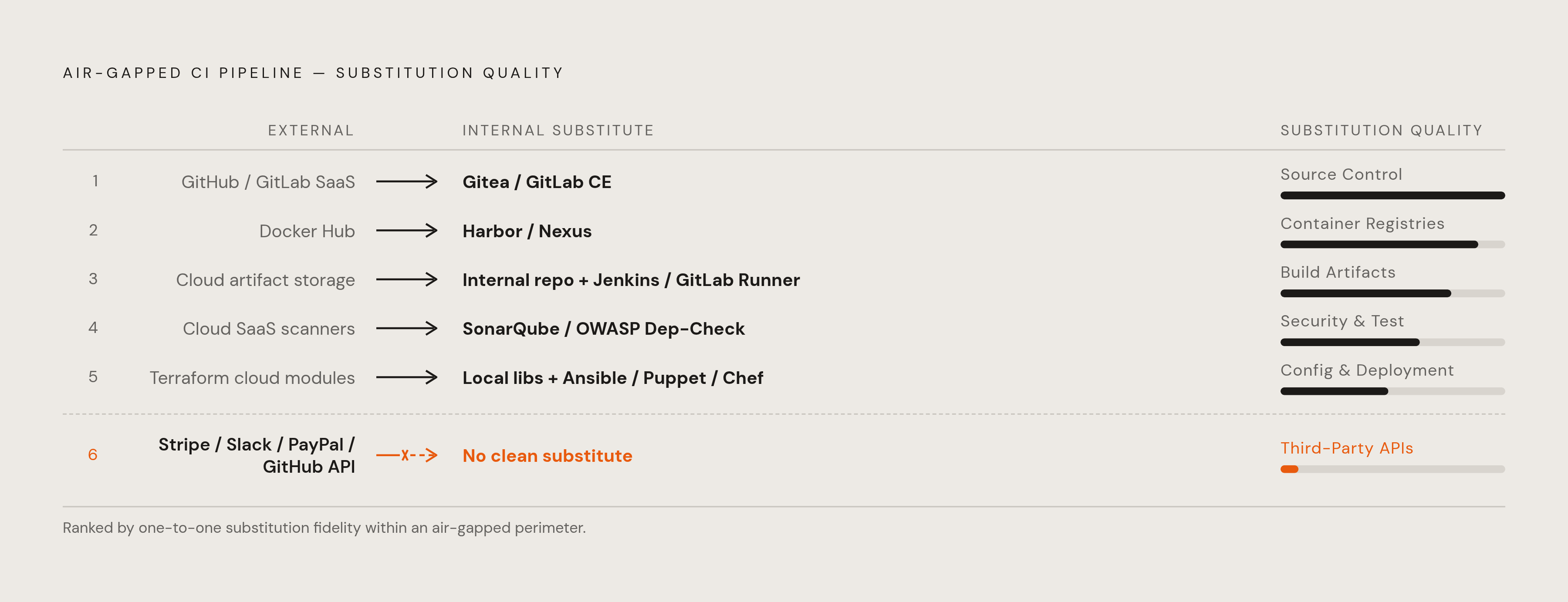
Source control built on cloud-hosted services like GitHub, GitLab SaaS, or Bitbucket cannot be reached from inside an air-gapped perimeter, so a self-hosted instance, GitLab Community Edition or Gitea, has to run internally, with the webhooks that normally trigger CI jobs replaced by internal event-driven mechanisms or job schedulers.
Container image registries built around Docker Hub or other public registries fail outright in isolation, so a self-hosted registry such as Harbor, Nexus, or a private Docker registry has to hold every approved image, with signing and verification enforced so tampered software cannot slip into production.
Build artifact storage has to move entirely to an internal artifact repository, with self-hosted CI servers, Jenkins, GitLab Runner, or TeamCity, executing builds strictly against internal resources and validating artifacts before they can reach production.
Security and test tooling, including SAST scanners, DAST tools, and SCA or vulnerability checkers like SonarQube and OWASP Dependency-Check, needs offline rule sets, because cloud-based license validation for commercial tools will fail silently or block runs entirely; logging and monitoring have to be reconfigured without dependence on external cloud log services.
Configuration and deployment tooling, Ansible, Puppet, Chef, has to operate entirely inside the perimeter, Terraform has to point to pre-approved local module libraries, and rollback strategies have to be built internally, since cloud-based rollback services simply are not reachable.
Each of these five layers has a known failure mode, and each has a known internal replacement. The sixth layer, third-party API integration, is where the clean one-to-one substitution breaks down, and it deserves its own extended treatment later in this piece.
Writing Pipeline Definitions That Assume Zero External Network Access
Solving the six layers at the infrastructure level means nothing if the pipeline definitions themselves still assume you have an open internet connection. The real discipline in offline CI is writing every pipeline file, every Jenkinsfile, every .gitlab-ci.yml, on the explicit assumption that no outbound network call will succeed, starting from the first line.
- docker pull node:20
- npm install
- npm run build
- docker pull registry.internal.local/node:20
- npm install --registry=
- npm run build
Every resource reference needs an internal address: docker pull commands must name the internal registry, and dependency installation steps must point pip, npm, or Maven at internal mirrors. Pipeline stages that would normally reach outward, container vulnerability scanning through a cloud API, SAST tools that validate licenses against a vendor server, notification webhooks, need internal equivalents or an explicit, documented decision to disable them. GitLab Runners need configuration that resolves only internal package mirrors, because a runner that quietly inherits a default external registry URL is a failure waiting for the day the network truly disappears.
Two reference architectures handle this well. You have to enforce internal-address discipline as policy across the team, not leave it as a habit individual engineers either remember or forget.
Third-party API calls: the layer offline pipelines leave unsolved
A team can do everything described above correctly and still leave its third-party API integrations, Stripe payments, Slack notifications, GitHub webhooks, PayPal flows, dependent on live external endpoints. Those integrations then become the single point of failure for the entire offline pipeline.
The assumption that breaks is a simple one: engineers tend to believe a vendor-provided sandbox is a safe substitute for a live API call inside CI. Even where a sandbox could theoretically be reached, it introduces its own instability: rate limits produce false-positive test failures, undocumented sandbox downtime blocks pipeline runs for reasons that have nothing to do with the code being tested, and schema drift appears silently between vendor releases.
The timing of this failure makes it worse than a typical infrastructure gap. The team finds out at the point in the process where a surprise costs the most time and the most trust.
Regulated environments carry an added risk. Neither option is acceptable in an environment where the entire premise of the pipeline is that nothing reaches outward. The only way out of that choice is to replace the live endpoint with something locally hosted and stateful enough to behave like the real thing.
Stateless mocks versus stateful simulators
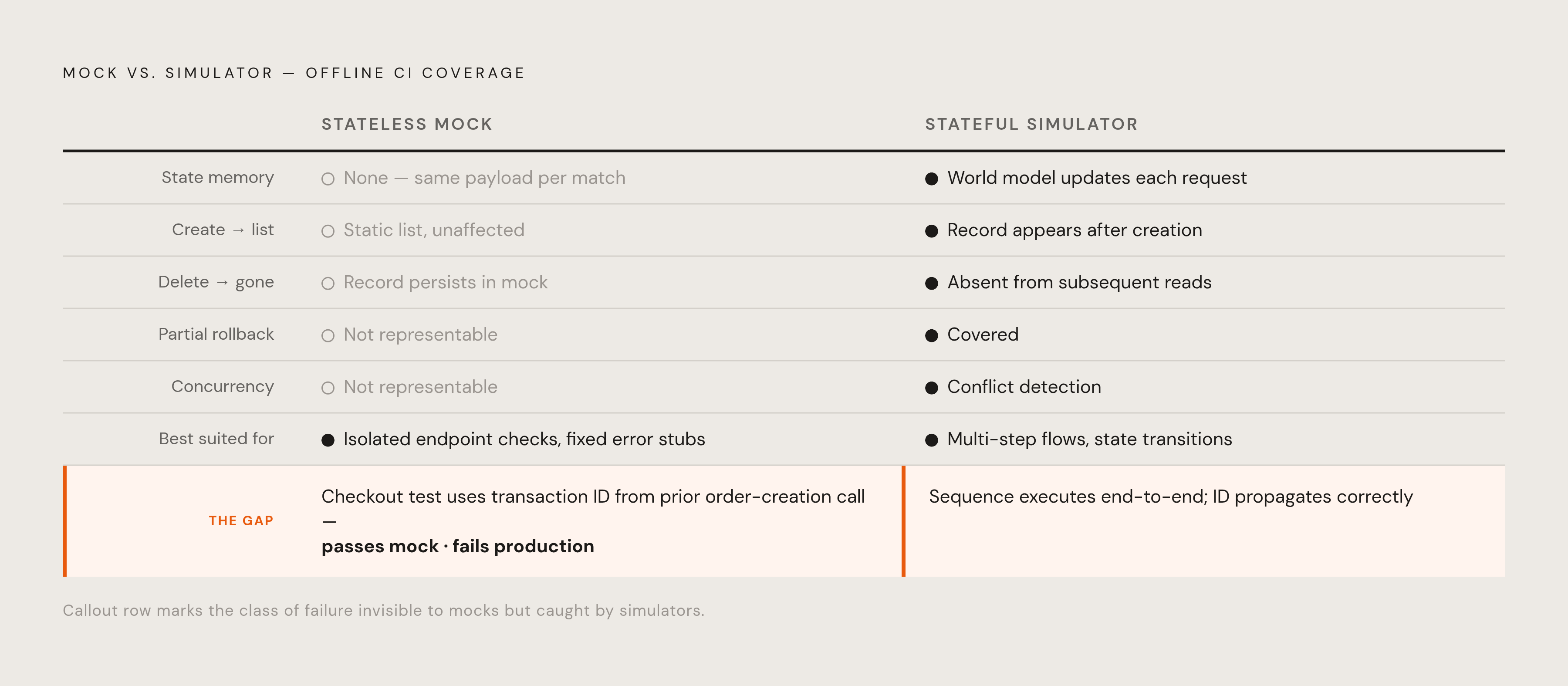
You cannot just return a canned response for each request when you replace a live API endpoint. A stateless mock has no way to represent the cumulative state that real API workflows depend on, so a test can pass cleanly against the mock and fail against the real service the moment it ships.
A stateless mock answers every matching request with the same static payload, no matter what came before it. That makes it useful for validating an isolated REST endpoint or confirming a specific failure response, but it has no memory of sequence. An e-commerce checkout test needs the exact transaction ID generated during a prior order-creation call, so it cannot pass against a stateless mock, because the mock never saw the order get created.
A stateful simulator behaves differently. The correct pattern is stateless by default and stateful by design, with the stateful layer handled by a simulator that resets cleanly to a known state between runs.
A simulator also needs to cover ground a mock cannot reach at all: valid state transitions, invalid or forbidden transitions, partial failures with rollback behavior, and concurrency conflicts under parallel execution. Under concurrent pipeline runs, statefulness introduces race conditions, stale reads, double processing, and eventual consistency gaps, the exact category of bug that passes in single-user QA and fails once it hits production traffic. A mock, by construction, cannot.
What a locally hosted stateful API simulator must do to be trustworthy in an air-gapped pipeline
A locally hosted API simulator earns trust inside an air-gapped pipeline only if it satisfies four specific properties: it remembers state across calls, it is continuously verified against the real API, it ships with realistic pre-seeded data, and it can inject faults on demand.
Stateful persistence is the baseline. The simulator has to maintain a world model that updates with every request, so a record created in one call appears in the next list call and disappears after a delete. Continuous verification against the live API matters just as much, because a simulator that is not regularly tested against the real service will drift quietly: a vendor updates a response schema, adds a required field, or changes an error code, and the simulator keeps returning the old behavior, handing engineers false confidence in tests that no longer reflect reality. That verification needs to happen before every simulator release, not as a one-time calibration performed at setup and never revisited.
Realistic pre-seeded data removes a different kind of friction. Pre-seeded data, plausible records, realistic IDs, populated relationships between entities, is what turns simulator testing into something engineers will actually use rather than something that is merely technically possible.
Fault injection belongs in the design from the start. Latency spikes, 429 rate-limit responses, 503 service-unavailable errors, and partial failures are the exact conditions offline CI exists to catch reliably. A simulator that cannot inject these faults at the call level leaves resilience testing unaddressed until the application meets those conditions for the first time in production.
Finally, the simulator itself has to meet the same air-gap standard as everything else in the pipeline. It needs to run without making any outbound network call of its own, no license check against a cloud endpoint, no telemetry phoning home, no runtime dependency on an external image registry. It has to be fully self-contained and able to scale horizontally across CI containers, the same requirement placed on every other piece of the stack.
Fault injection and resilience testing in offline CI
Resilience testing against injected faults, timeouts, rate limits, partial outages, cannot be treated as an optional exercise reserved for late-stage hardening. In air-gapped CI it is more achievable than in a live environment, and it belongs in every pipeline stage as a standard, repeatable gate.
The fault types that matter for API-dependent software fall into a few categories: probabilistic failure rates, where a configured percentage of calls returns a 500; rate-limit responses, 429s carrying retry-after headers; latency injection, calls deliberately slowed enough to trigger client-side timeouts; and service-unavailable responses, 503s standing in for vendor downtime. Inside an air-gapped simulator, every one of these faults is declarative and repeatable, called up exactly when the test needs it.
Chaos engineering has moved past ad-hoc scripts, so now you see structured, declarative experiment definitions with validation gates built directly into CI/CD. The right pattern is to automate these fault-injection experiments as a regression stage, not a one-off exercise: once a workload meets an experiment's hypothesis, the experiment reruns on every subsequent build, catching regressions in resilience behavior the same way a unit test catches a regression in logic.
Running this offline rather than deferring it to staging produces a specific benefit: a controlled, offline fault-injection run gives deterministic results. A staging environment that calls live APIs introduces variability from the vendor's own reliability on that given day, which makes it genuinely difficult to tell whether a test failure traces back to the application's own bug or to an incident on the vendor's side. Determinism is the entire point of a CI gate, and a live dependency takes that determinism away.
Testing AI agents that call external APIs in an air-gapped CI environment
AI agents that call external APIs while executing a task run into the same offline CI problem as traditional software, but the evaluation challenge is harder, because a single wrong API response at any point in a multi-turn trajectory can invalidate the entire trace, not just one test case.
When you build production-mirrored environments for agent evaluation, the results transfer once the agent reaches deployment. Research groups working on this problem have already demonstrated the offline approach concretely: fully local stand-ins for services like Messenger, Gmail, and Facebook-equivalent platforms run on internal ports and expose the same kind of APIs for searching, reading, and sending messages that an agent would call in the real world, fully isolated from any actual external service.
The Tongyi DeepResearch team built an offline environment based on a 2024 Wikipedia database and developed a suite of local RAG tools to simulate the web environment for agentic reinforcement learning training, then used a data synthesis pipeline to generate QA specifically for that offline setting. On the evaluation side, an agent-as-a-judge architecture supports the kind of nuanced, multi-step assessment this work requires: a judge agent explores the full trace, assesses the tool-call trajectory, and applies a rubric, which maps directly onto offline regression testing where the ground truth is the expected API state after a defined sequence of calls.
A stateful simulator works for agent evaluation for the same reason it works for ordinary integration testing. The infrastructure built to solve offline API testing for conventional software is the same infrastructure that makes agent CI tractable.
Keeping an air-gapped pipeline current: update orchestration, drift detection, and ongoing compliance
Standing up an air-gapped CI pipeline is a one-time achievement. Keeping it current, verified, and compliant is the ongoing discipline that keeps it trustworthy instead of letting it drift quietly into a false sense of security.
Security patches and version updates need a structured, auditable path into the environment: a hardened transfer station that verifies the authenticity of each update, tests it in a staging environment that matches production before promotion, and uses write-once media to enforce one-way data transfer. Container images and artifacts need their own periodic audit against a known-good manifest, enforced through the registry's signing policy, because the normal signal that triggers an update in a connected environment, a notice from a public registry, never arrives inside an air gap.
API simulator drift deserves the same scrutiny as dependency staleness. A simulator that accurately reflected a vendor's API at the moment it was imported will drift as that vendor evolves the real service, and the only real defense is continuous verification before every release, with fidelity scores published so a team can audit whether its locally hosted simulator still matches real behavior before it gets promoted into the pipeline. In regulated industries governed by standards like HIPAA or PCI DSS, the air-gap boundary itself has to be documented, its integrity verified, and any inbound data transfer logged with full chain-of-custody records.
None of this makes an air-gapped environment automatically more secure than an internet-connected one. Physical isolation only becomes real security when the components inside it are kept current through continuous verification, of packages, of images, and of API simulators alike. The team that stood up its Git server, mirrored its package repositories, and configured its container registry correctly did necessary work, but it left the job unfinished if its payment flows and notification hooks still depend on a live endpoint. Applying the same verification discipline to the API layer that gets applied to every other layer is what actually closes the gap, separating a pipeline that looks finished from one that is.