Rate Limit Errors in CI Pipelines Caused by Third-Party APIs
Shared credentials and concurrent requests collide with provider rate limits in automated testing.
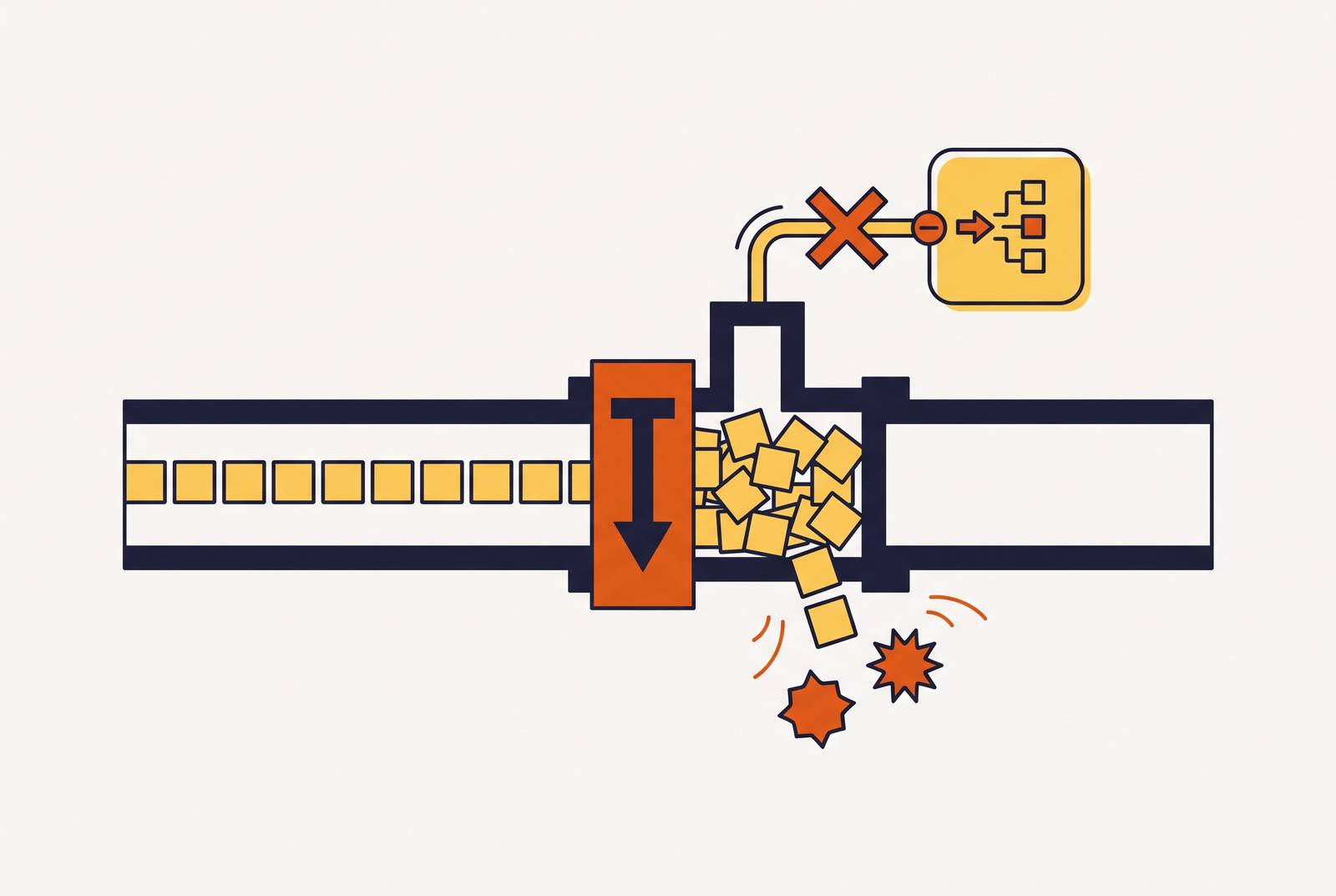
Rate limit errors in CI pipelines are the predictable result of automated, concurrent, high-frequency environments calling live third-party APIs: throttling. Consider a CI collect job in the quirq-ai/test-pipelines repository that exhausted its per-repo GITHUB_TOKEN quota and logged nothing more descriptive than "HTTP 403 Forbidden," a message indistinguishable from a missing-permission error. The presubmit for the affected pull request turned red, and someone had to open a separate investigation just to learn that the token had simply run out of requests, not that any permission had been misconfigured.
That incident is not an anomaly; it's the natural consequence of how CI pipelines are built. CI systems poll APIs repeatedly to check status, they fan out across parallel jobs to speed up builds, and they often share a single authentication context across every one of those jobs. Each of those three habits, alone, is a reasonable engineering choice. Primary rate limits set a fixed ceiling on requests per hour, and secondary rate limits are behavioral throttles triggered by suspicious request patterns, so both respond to this pattern because it is what they were built to catch. A pipeline that calls a third-party API this way will hit a ceiling. A pipeline built this way will hit that ceiling eventually.
How the errors surface: misread signals and misleading headers
Rate limit failures rarely announce themselves as rate limit failures. A token's quota can run out, and when it does, GitHub returns HTTP 403, the same status code you get for insufficient permissions, so if your presubmit fails you'll likely check repository access settings before you think about throughput. The quirq-ai/test-pipelines PR #27 fix documents this ambiguity directly: a 403 born from an exhausted GITHUB_TOKEN reads identically, on its face, to a 403 born from a missing scope.
The confusion deepens because no two providers describe the same concept the same way. GitHub communicates reset timing through an X-RateLimit-Reset header expressed as a Unix timestamp. There is no normalized contract across these systems, so a debugging script or a human reading logs across two or three integrations has to hold three different mental models at once just to answer the same question: how long until this works again?
Secondary rate limits are harder to predict, because they are not tied to a fixed request count. They trigger instead on behavioral heuristics, like request velocity or identical queries repeated in a tight loop, so a pipeline can stay under its documented hourly ceiling and still get throttled, with no clear signal telling you why. The live-API approach costs more than its downtime; it costs the hours spent treating a throughput problem as a configuration problem.
Retries and backoff as a local fix for a system-level problem
Retry logic with exponential backoff is the right response to occasional, transient rate limits in production traffic, where a user's request fails once and a brief wait resolves it. It is the right response only to occasional, probabilistic rate limits; in CI, the underlying cause is architectural and predictable. A CI pipeline hits a rate limit because it was built to poll, fan out, and share credentials, and it will do all three again on the very next run regardless of how gracefully the last failure was handled.
A poorly handled retry loop in CI can do damage well past the single job that triggered it. In a multi-tenant integration architecture, a single misbehaving sync job or one overzealous CI run can burn through the shared rate limit budget for every other customer on that same integration, so the damage is never bounded to the pipeline that caused it.
Retry logic treats the 429, not the reason the 429 appeared: a live API being called from an environment built to overwhelm it. If the architecture producing the request pattern stays the same, the next run hits the same errors under the same conditions. That's flakiness, not reliability, and flaky CI does lasting damage: it erodes trust in the test suite itself, to the point where a red build gets re-run on reflex rather than investigated. Retries belong in production clients, where the problem really is occasional and probabilistic. CI needs a different fix, because its problem is architectural.
What AI agents and agentic CI workflows add
AI agents running inside CI pipelines don't just add to API request volume, they multiply it, turning a rate limit budget that was already tight into a near-certain ceiling hit on every run. A conventional CI step makes one API call, or just a small, countable few. An AI agent takes a single task and fans it out into many LLM calls and many tool calls, and each of those tool calls may itself reach out to a downstream API, so the request count for what looks like "one job" in a pipeline definition can be an order of magnitude higher in practice.
A GitHub Copilot agentic workflow failure documented in the gh-aw-firewall issue tracker shows this directly. That issue listed reducing concurrent workflow volume or reviewing provider quota and rate-limit policies as remediation options, and it listed retrying after a short delay as the primary recommendation. That answer manages demand or upgrades quota; it does not change the architecture producing the demand, and it's the same palliative response the retry argument already produces at the traditional-CI scale.
Why stateless mocks don't solve the problem either
Stripe's own stripe-mock documentation states that it does not synchronize settings and capabilities with live, and that they can diverge from live settings and capabilities at any time. That admission, coming from the company that built the tool, is unusually candid, and it names the exact failure mode that undermines every stateless mock: the response you get back in testing is not a guarantee of what the real API will do.
A stateless stub returns the same hardcoded response every time, regardless of what happened on any prior call. It cannot express the sequences that integration testing actually needs to verify: create a resource, fetch it, update it, fetch it again, and confirm the state actually changed. Drift between a stub and the real API shows up in specific, quiet forms. None of these get caught by a stub written before the change happened, because the stub has no mechanism for noticing that the world moved.
Contract tests are a reasonable objection here, and they do real work, but they verify schema shape, not behavior across a sequence of state changes. A contract test can confirm that a cancellation endpoint returns the fields it's supposed to return. It cannot tell you whether canceling an order and then fetching that order afterward returns the status your application logic actually depends on.
What a stateful, locally hosted simulator does differently
A stateful simulator that runs locally or inside CI remembers what happened on prior calls: create a record, list it, cancel it, fetch it again, and the world reflects that history accurately. Integration testing needs that behavior, and a stateless mock cannot offer it no matter how carefully you write its individual responses.
Several properties distinguish this architecture from both the live API and the stateless mock. The simulator is hosted locally, so it is not subject to any provider's throttling policy. State is deterministic and repeatable: tests can seed the simulator with realistic pre-populated data before each run and reset it afterward, so every run starts from a known baseline instead of whatever condition a shared sandbox happens to be in. Fault injection becomes a first-class capability rather than an accident, since the simulator can be instructed to return 429s, 503s, or high-latency responses on specific calls, turning resilience testing into something repeatable and gatable in CI. The pipeline can also run fully offline or air-gapped, with no outbound connectivity to the provider needed, and that matters if your enterprise environment enforces strict network egress controls.
None of that solves the fidelity question by itself. A simulator that drifts from the real API it is modeling fails in exactly the way a stale stub fails, just with more surface area. The only durable answer to drift is continuous verification: running the simulator's responses against the live API before every release to confirm they still match.
Verifying that a simulator stays accurate as the real API changes
If you don't continuously check a simulator against the live API, it will drift silently and hand developers false confidence, the same failure mode that defeats hand-written stubs, just at a larger scale and with more at stake. Drift shows up in specific, detectable forms: schema mismatches, where a field typed as an integer now returns a string; structural shifts, where a key gets renamed with no version bump to flag it; behavioral changes, where an endpoint that used to return 204 now returns 404; and security regressions, where a mandatory auth header quietly disappears from a response.
The verification model that catches these problems mirrors how engineers already guard against database migration failures: snapshot the expected behavior, run that snapshot against the current real API, and flag the delta before it reaches any consumer. If you apply that same discipline to a simulator, it stays accurate and no one has to manually review every changelog a provider publishes.
Vendor-provided sandboxes are not a substitute for this discipline, and the vendors say so themselves. Kalshi's demo environment, hosted at demo.kalshi.co, uses mock funds and credentials kept separate from production, a sensible safety measure, but neither Stripe's nor Kalshi's documentation promises that sandbox behavior matches live behavior at the level of individual response bodies.
That gap matters more as the callers testing against these systems stop being only humans running a QA checklist. An AI agent deciding how to call a function relies on a tool description, the schema that tells it what fields exist and what they mean, and drift in that schema can cause the agent to call an endpoint incorrectly even when the HTTP layer itself succeeds and returns a technically successful response. Verifying a simulator against the real API has to include response-body fields, not only status codes, to catch this failure mode before an agent does. When a simulator publishes its fidelity score openly, an engineering team gets a reason to trust that verification.
Fault injection: testing how the pipeline behaves when the simulator deliberately misbehaves
Removing live API calls from CI does more than cut out a failure source. It opens up a class of tests that live APIs make essentially impossible to run on demand: deliberately injecting the 429s, 503s, high-latency responses, and malformed payloads that a live API produces unpredictably, and then asserting that the pipeline actually handles them correctly.
A locally hosted simulator can be configured to return a 429 carrying a specific Retry-After header, a 503 with a specific body, or a response with one intentionally malformed field, triggered on a given call number or after a specific sequence of prior state changes. So a CI gate can check resilience behavior before every release, and no one has to discover it in production when the real API finally has a bad day. The relationship with rate limit errors inverts entirely: instead of hoping a pipeline avoids them, engineers write tests proving the pipeline survives them.
Research into chaos engineering for agent systems, published as AgentChaos, points at a gap current tooling largely misses: fault injection at the response-body level, where an endpoint returns a technically successful HTTP response but with wrong or malformed fields inside it. That failure mode is invisible to anything checking status codes alone, and it's exactly the domain a stateful simulator is built to cover, since it controls both the status and the body on every call it serves. Fault injection belongs in the pipeline as a deployment gate, not as a chaos exercise you run once a quarter. A simulator makes that practical because its faults are deterministic and resettable, unlike random failures that need live infrastructure to cooperate on command.
Migrating a CI pipeline from live API calls to a stateful simulator
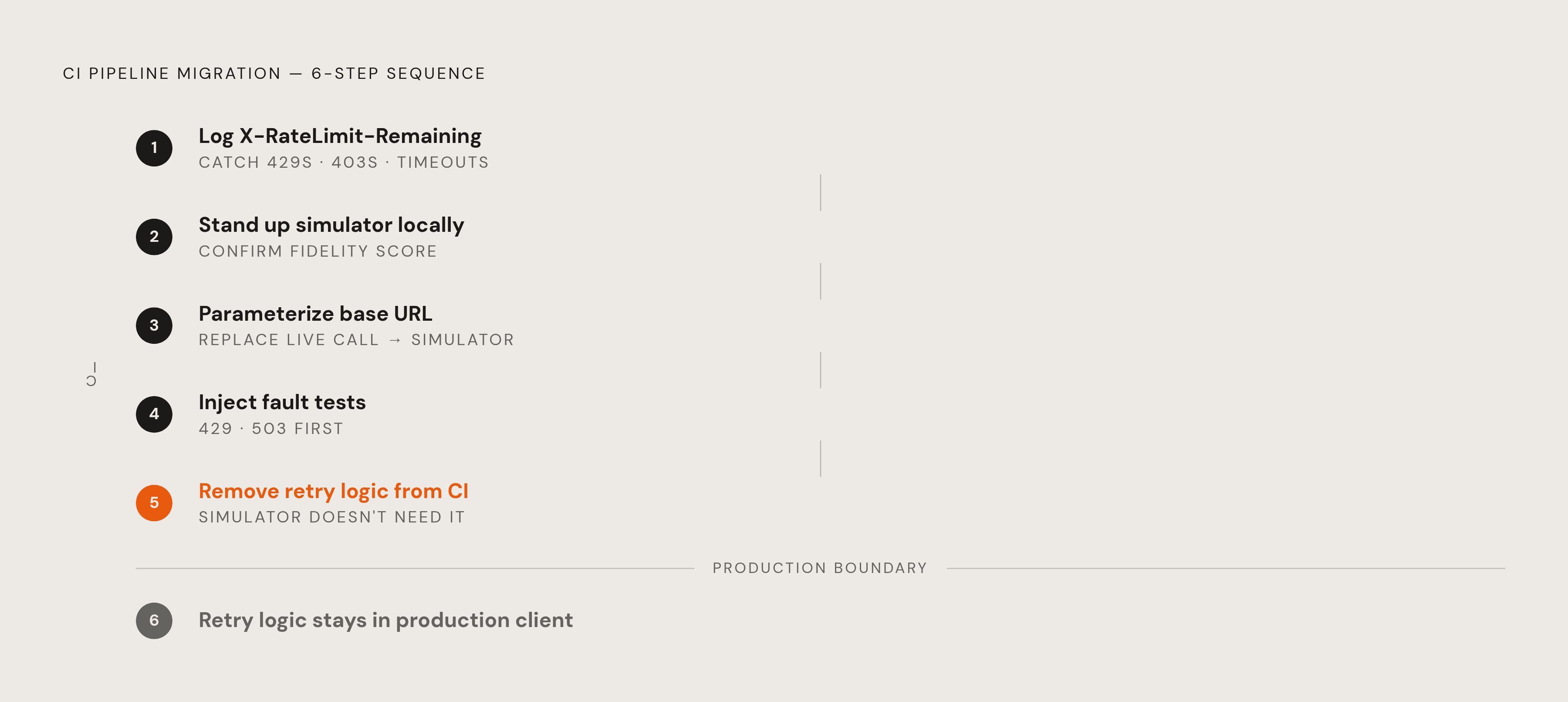
You don't have to replace every live API call on day one when you migrate off them. The highest-value starting point is the subset of calls most responsible for rate limit errors or flaky results, which is usually the polling and list-fetching patterns, not single-resource reads.
A practical sequence for the migration:
- Identify which third-party API calls in CI are producing 429s, 403s, or timeouts. Logging headers like X-RateLimit-Remaining on every response is a useful diagnostic step before any migration begins, and it tells you where to start.
- Stand up the simulator locally and confirm the endpoints the pipeline needs are covered, with a fidelity score acceptable for the use case at hand.
- Replace the live API call in the CI job with the simulator endpoint, parameterizing the base URL so the same test can point at the simulator in CI and, separately, at a staging environment for integration checks when needed.
- Add at least one fault injection test for each error mode the pipeline previously hit unexpectedly, starting with 429 and 503 responses.
- Remove retry logic from CI jobs that now call the simulator. Retries in CI exist to paper over live API unreliability, and once live calls are gone, retries only add latency and obscure real test failures.
- Keep retry logic in the production client code, where it still calls the live API and still legitimately needs it.
Teams building or evaluating AI agents that call external services should treat the same simulator as the right substrate for reinforcement learning environments, since it's deterministic, carries controllable state, and scales horizontally across many containers without multiplying API quota consumption, the same property that makes it the right fix for CI makes it the right foundation for agent training and evaluation.