Resetting API Simulator State Between Test Runs Without Restarting the Server
Use a dedicated reset endpoint to isolate stateful API tests without server restarts.
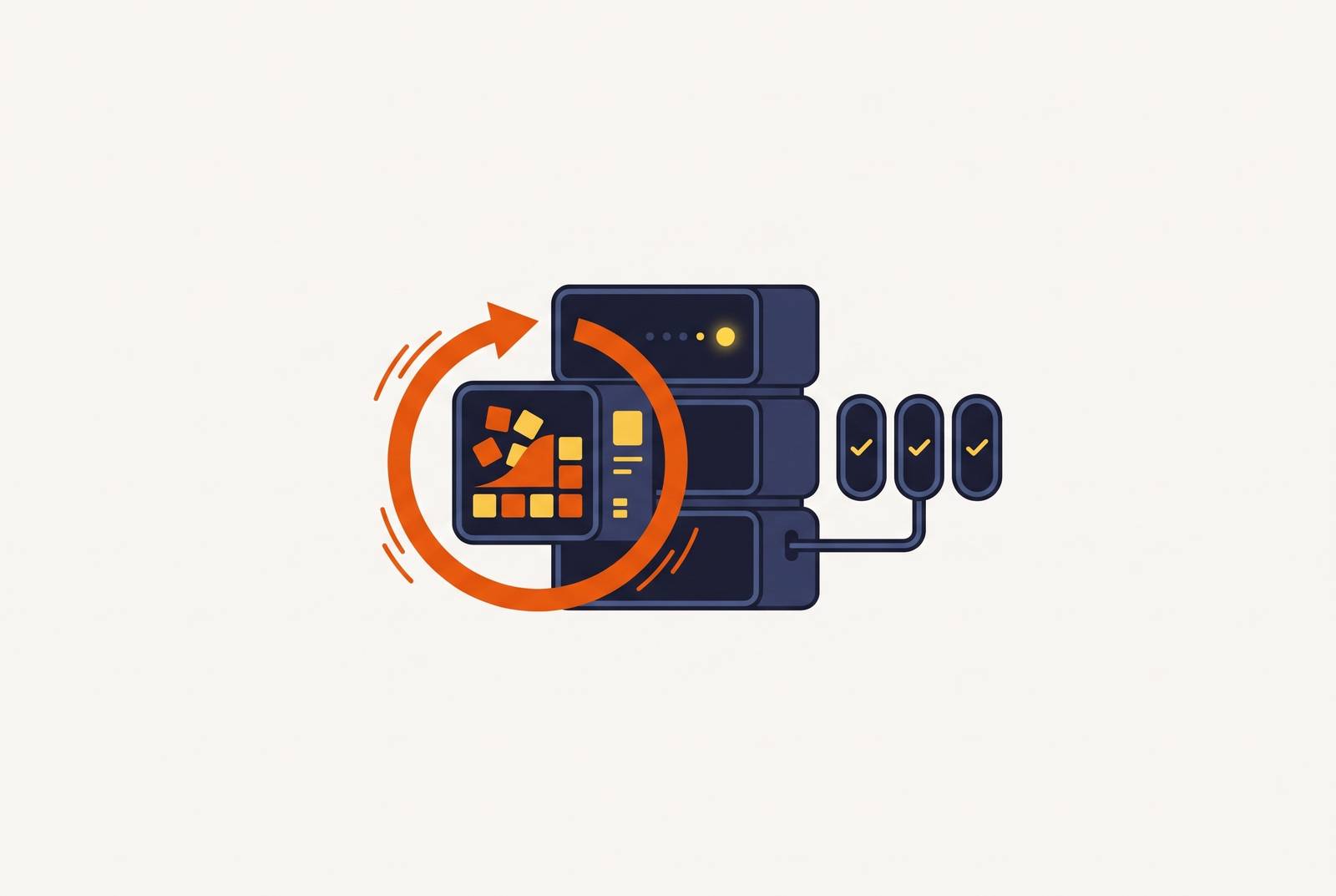
Integration testing against stateful APIs requires a simulator that preserves the effects of API calls within a test and restores a known baseline before the next one. A dedicated reset API, such as POST /reset, provides that isolation in milliseconds without restarting the server. This lets tests run realistic workflows without hitting production, keeps parallel workers separate, and keeps the order in which tests run from affecting their results.
Why restarting the simulator to get clean state is the wrong default
Restarting a simulator turns test isolation into an infrastructure lifecycle operation. The process shuts down, the port is released, data is re-seeded, the server binds again, and the test runner waits for a health check. None of that time exercises the application under test. It is dead time between useful work. The intended change is to the simulator’s world, yet the restart also rebuilds the machinery that serves it.
Each worker pays the same lifecycle penalty, so adding workers multiplies the restart work. Restart also disrupts the continuity that realistic test environments may need, including open WebSockets, persistent authentication tokens, and streaming subscriptions. Those should not disappear just because a test created an order. Process lifetime and test-state lifetime are different concerns, and tying them together makes clean state needlessly expensive.
What state actually needs to be reset, and what does not
A simulator has several kinds of state with different reset requirements. Call history records which endpoints were called, with what arguments, and in what order. It usually needs clearing before each test so assertions describe only that run. Resource state is different from this record of activity. Users, orders, payments, and messages need to return to a pre-seeded baseline.
Scenario configuration is another layer of state with its own reset needs. An endpoint configured to return an error, timeout, or malformed response remains altered until that override is removed. Module-level and singleton state can be less visible. Counters, cached tokens, and sequence IDs may change what the simulator does without showing up in the call history. A reset contract that covers only recorded requests and visible resources therefore leaves part of the environment uncontrolled.
The in-process mock vocabulary of clearing, resetting, and restoring helps distinguish these jobs. For a stateful simulator, clearing removes the record of previous activity, resetting returns resources to their starting condition, and restoring removes scenario overrides in favor of configured defaults. These operations have different targets and different consequences. Clearing history alone leaves the world changed, while wiping every default can destroy the fixtures that make a test useful. Over-reset can leave tests passing in a world too empty to test anything useful.
How a hot-reset endpoint works and what it must guarantee
A hot-reset endpoint accepts a single HTTP call, such as POST /reset, while the simulator remains running. Its successful response must mean that the baseline is ready for the next test. That is the endpoint’s essential completion guarantee. The caller must be able to proceed knowing that previous resource changes, call history, and scenario overrides no longer affect the test. The operation must also account for hidden state that influences those behaviors.
Resource reset must undo creations and mutations involving orders, payments, messages, subscriptions, and webhooks, returning them to the pre-seeded world. Call history must start from zero. Fault-injection settings must return to their defaults as part of the same atomic operation. While this happens, the process stays alive, the port stays bound, and long-lived client connections stay open. Reset should complete in milliseconds so isolation does not become another meaningful setup delay.
The baseline gives that guarantee its practical value. A Slack workspace needs coherent channels and members, a Stripe account needs products and customers, and a GitHub repo needs issues and pull requests. Empty is not a substitute for realistic. Test setup should move cleanup from afterEach to an endpoint call in beforeEach. Resetting before a test runs gives it a clean start even if the previous test crashed before teardown.
Why testing APIs where order of operations matters makes reset essential
Stateless stubs have no persistent world for a test to corrupt, but that simplicity limits which workflows they can test. Creating a payment and fetching it should return the payment that was created, with the matching ID. A fixed fixture cannot establish that causal relationship. An order should also move through confirmation and shipping, and reads after each step should show the change. Returning the same status at every stage does not test the sequence.
Conflicts and polling also depend on what happened earlier. An attempt to create a resource that already exists should produce the correct 409 response because the simulator knows that resource exists. A job that begins as “processing” must be able to reach “complete” after enough calls. A fixed response cannot show both of those states.
That dependency is useful within a test and dangerous between tests. A test that creates a batch of orders leaves a changed world behind unless reset removes its effects. The next test’s “list orders” assertion can then pass or fail according to execution order. This contamination is a direct consequence of modeling persistence. Correct isolation preserves cause and effect throughout one workflow, then removes that workflow’s influence before another begins.
What a reset endpoint changes in a CI pipeline that runs tests in parallel
Parallel CI needs a clean start for each test and a boundary between workers. A global hot reset cannot provide that boundary if it erases resources another worker is using. The reset scope must match the isolation scope. Without that match, keeping the process alive only replaces restart disruption with state disruption.
One valid architecture gives each worker its own simulator instance and resets it before every test. Workers remain independent, and their resets need no coordination with one another. Each worker pays for its own process. With hot reset, the worker’s test loop can keep going without another shutdown, startup, or wait for a health check. Independence makes this architecture straightforward to scale.
The alternative shares one simulator while assigning each worker an isolated namespace, such as a named workspace or tenant. Reset then clears only the requesting worker’s namespace. This cuts process overhead but needs reset logic that is more precise. A restart cannot preserve that boundary because it stops the shared server for everyone, forcing coordination that undermines parallel execution. In either architecture, the hot-reset call belongs in the setup hook, where its millisecond-scale work remains local to the test and leaves the pipeline uninterrupted.
Fault injection state as the reset concern most teams overlook
A test that injects a 503 or a latency spike changes the simulator just as surely as a test that creates an order. Unless reset explicitly removes that configuration, subsequent tests inherit it. The symptoms point in the wrong direction. Leaked orders appear in list responses, but a leaked 503 from a payment endpoint disguises a test-isolation failure as a service outage.
The reset surface extends beyond obvious server errors. It includes injected HTTP codes such as 400, 401, 403, 429, 500, and 503, as well as artificial latency, timeouts, malformed responses, and connection-reset behavior. Structurally valid responses can also contain injected faults. A payment marked “succeeded” when it should be “pending” can arrive as valid JSON with HTTP 200. Status-code assertions will not identify that contamination, even though it changes the application’s decisions.
The reset contract must therefore restore both scenario behavior and resource contents. Its neutral state has no injected faults and no artificial latency, unless those behaviors belong to deliberately configured defaults. Resource cleanup alone cannot establish that condition. Fault restoration must occur atomically with the resource reset so the endpoint’s successful completion describes a coherent world. Otherwise, the next test may receive clean data through an endpoint still configured to misbehave.
How agent and RL evaluation workflows expose the same reset requirement at larger scale
Tool-using agent evaluation requires the same isolation as an integration test, repeated across trials. An agent changes the simulated world through its actions, and the next trial must not inherit those changes. Manual cleanup and process restarts become impractical as evaluation expands, while incomplete cleanup changes the conditions being measured. The same hot-reset endpoint used before a CI test supplies the clean starting point for an agent trial.
τ-bench introduced pass^k at ICLR 2025 to measure whether an agent solves the same task across all k independent trials. That metric depends on each trial starting from an identical world state. Residue from earlier trials can inflate or deflate the result, mixing reset quality into an apparent measure of agent reliability. Independence is a requirement. A trial that encounters resources or fault settings left by its predecessor is not a clean repetition of the same task.
ReliabilityBench (2026) measures consistency under repeated runs, robustness to semantically equivalent task perturbations, and fault tolerance under injected tool failures. Each dimension requires per-trial reset so intended changes remain distinct from accidental contamination. Fault testing adds the same hidden-state problem found in CI. AgentChaos (August 2026) found that omission faults sent through HTTP 200 responses, including empty or truncated content, were especially damaging and hard to spot. Reset must remove these changes to responses even when ordinary status-code checks show no sign that an injected fault is still active.
Reinforcement learning needs this across thousands of containers, each with a simulator instance that can be reset on its own. Restart overhead multiplies across that fleet and can dominate training cost. A near-instant reset keeps each container’s environment reusable. The scaling requirement does not change what reset means, however. Every new trial still needs baseline resources that fit together, history that has been cleared, and fault settings that have been restored, all without rebuilding the process that serves them.
What a simulator’s reset endpoint reveals about the fidelity of the simulator itself
A comprehensive reset endpoint shows whether a simulator has modeled its own state explicitly. If resources return to baseline but counters or scenario overrides survive, the reset boundary is incomplete. That gap is more than a setup defect. It reveals behavior that the simulator cannot reliably bring under control, which weakens confidence in the tests built on it. A correct reset requires an account of every state dimension that can influence the next run.
A simulator can reset perfectly to a baseline that no longer matches the real API. Continuous verification against that API keeps the restored data and response schemas meaningful. Leaked state and API drift create the same underlying risk, allowing tests to pass against conditions that differ from the system the application will actually use.
The Kalshi Python SDK’s nightly spec-drift tests throughout October 2026 illustrate the risk. The SDK contract suite no longer matched the upstream OpenAPI spec because the required field corporate_action_payments in kalshi.perps.klear.models.margin.ObligationEntry had no SDK mapping. A simulator seeded from that contract would restore an incorrect baseline. Reset speed could not repair the missing field. Trust in reset therefore depends on two forms of verification, proving that the operation restores the whole modeled world and proving that the restored world still matches the real API.