Choosing a Stateful API Testing Tool When Your Workflow Lives in Localhost
Stateful simulators catch multi-step API failures that stateless mocks hide from integration tests.

Integration testing against stateful APIs requires a simulator that preserves resources across calls, enforces transition rules, and resets deterministically between tests. For a localhost workflow, the strongest choice also runs offline, injects failures, and publishes verification against the real API.
Why stateless mocks silently break multi-step API workflows
A create-order → poll-status → cancel test breaks when every request for status gets the same fixture back. The polling loop either runs forever or exits immediately. The returned ID does not match the resource created, and the 409 conflict path is unreachable. Each response can look correct in isolation while the sequence fails to represent an order’s lifecycle.
The cause is a lack of memory. A stateless mock operates as a lookup table, matching a request pattern and returning a preconfigured response without retaining what earlier calls did. Payment charges, refunds, checkout sessions, GitHub PR lifecycles, and Slack channel membership all depend on that history. A mock simulates an API’s interface, including request and response shapes, while a simulator reproduces its behavior through state transitions, business logic, and resource lifecycle. That distinction establishes what an integration test can actually prove.
The four levels of simulation fidelity and where tools actually sit
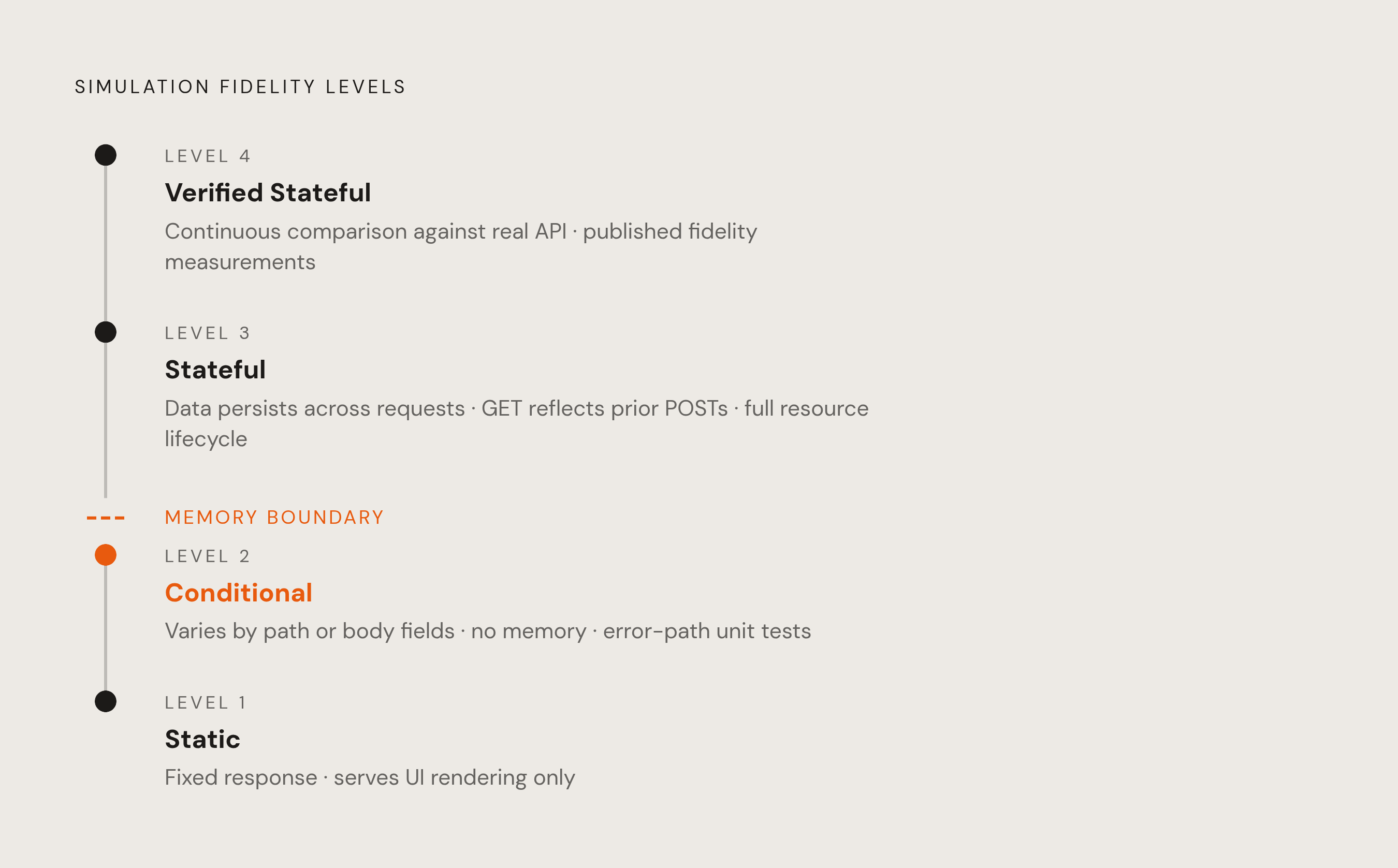
Simulation fidelity has four levels, distinguished by what determines the next response. Level 1 is static: it returns the same fixed response for each endpoint, whatever is in the request. It serves UI rendering. Level 2 is conditional: its responses change with the path parameters or body fields, but it has no memory of past requests. It works for many error-path unit tests, but it cannot model a resource lifecycle because request matching does not tell it what happened before.
Level 3 is stateful, preserving data across requests so that created resources can be read, listed, updated, and deleted. A GET reflects earlier POSTs and PATCHs. Level 4 adds continuous verification against the real API before each release, with published fidelity measurements. Only these upper levels can faithfully reproduce multi-step workflows. They differ in whether the implemented behavior is also checked against the service it represents.
This taxonomy is a diagnostic lens. A conditional response can look convincingly dynamic without being stateful. A tool can also store resources correctly without showing that its transition rules still match the live API. The first distinction concerns memory, while the second concerns accuracy over time. A tool described as a “simulator” therefore earns its placement through demonstrated behavior and verification.
What a state machine requirement actually looks like in practice
A simulator needs named transitions, such as created → captured → refunded, and response bodies that show the state after each change. Returning a different fixture is not enough. The resource’s stored state must change so that later reads show the same payment lifecycle. Otherwise, the apparent transition exists only in the response that announced it.
Transition guards establish which operations are legal. Attempting to refund an uncaptured charge must return the documented error. A simulator that accepts the operation validates code the real API would reject. Deterministic reset also makes sure the environment is back at a known baseline before each test. Without it, earlier tests can change later results and make CI execution order-dependent.
For evaluation, the practical check is one unbroken sequence that creates a resource, reads it by ID, updates it, and confirms the update in a subsequent list. No test-setup boilerplate should run between those calls. That code can hide a lack of persistence by building the expected answer outside the simulator. A second check attempts an invalid transition and compares the rejection with the documented error.
The drift problem: why a stateful simulator that isn't verified will lie to you eventually
Drift occurs when a simulator’s behavior diverges from the real API while local tests continue to pass. Statefulness alone cannot prevent this failure. Hand-maintained mocks need someone to change them each time the API changes, and those updates often wait until something breaks. Spec-generated simulation slows that process but cannot eliminate it because the specification itself can lag the live service. A correctly generated implementation of a stale specification remains wrong.
The resulting failure can involve a transition, an error code, or a field name that the simulator models incorrectly. Tests then provide confidence in the wrong behavior. Vendor sandboxes can suffer the same problem when they lag production features or behave differently from the live API. Nor is complete reimplementation a sound escape route, since deeper business-logic simulation approaches a parallel service with its own bugs and maintenance burden. The appropriate boundary is resource lifecycle and transition rules.
To measure fidelity within that boundary, the simulator must be compared with the real API regularly, with differences measured and published. A fidelity score without continuing updates is only a snapshot. Level 4 therefore requires verification before every release, making cadence part of the tool’s qualification.
Evaluating the real tools: vendor sandboxes, open-source simulators, and verified stateful options
Stripe’s sandbox provides an isolated copy of an account with its own API keys, webhooks, and data. Stripe recommends general sandboxes for new integrations over legacy test mode, which remains available. PayPal’s sandbox uses test buyer and seller accounts to validate payments, while Kalshi provides a full sandbox at demo-api.kalshi.co. These are genuinely stateful, level 3 environments, but they require internet access and credentials. They do not satisfy an offline localhost requirement, and vendor-side rate limits, drift, and downtime remain dependencies.
Against the same criteria, vendor sandboxes provide state persistence, transition guards, and realistic test environments, but their verification cadence is opaque. Native API fault injection is not supported in this comparison. Their role is therefore distinct from a credential-free local simulator. They provide vendor-managed testing environments without removing the external dependencies that can make CI fragile.
FetchSandbox covers Stripe, Clerk, GitHub, Paddle, Resend, and Shopify webhook events. Events fire on real transitions, and replay supports idempotency testing without production keys. That places its webhook and event flows at level 3. Its builder explicitly describes it as schema-accurate rather than logic-accurate, so it does not model vendor-specific card behavior such as which test card numbers succeed or decline. It supports local testing, but verification scores are not published, while transition guards, fault injection, and realistic seeded data are partial.
pay-sandbox is an open-source, MIT-licensed npm tool for Stripe, MoMo, ZaloPay, and VNPay. It runs locally with one command and needs no accounts, tunnels, or internet. Its level 3 coverage includes customers, PaymentIntents, charges, refunds, Checkout Sessions, and events, with signed webhooks, retries, chaos testing, and a live dashboard. Its transition behavior is scoped to that subset, excluding prices, subscriptions, and 3DS flows, with verification scores unpublished and pre-seeded data unstated.
Karate DSL supports a first-class mock server using the same DSL as its tests, including stateful mocks. It reaches level 3 when that capability is used. The state remains developer-maintained, so its drift risk follows the maintenance of those definitions, with no published verification cadence. Its local mock server can be used for localhost testing, but its documentation lists no built-in way to inject faults. A level 4 tool must publish up-to-date comparisons with the real API as well as store state locally, and it must also show that it works offline and has fault controls.
Fault injection as a required testing dimension, not an optional add-on
A simulator that returns only correct responses cannot establish whether an integration handles failures. Successful transitions test only part of the workflow. Resilience testing spans network faults such as latency, packet loss, bandwidth throttling, and DNS failure, as well as API responses such as 500s, 429s, 503s, and timeouts. Agent workflows add content-level faults, including structurally valid responses containing wrong or truncated information. These layers require different controls because they interrupt different assumptions in the client.
A fixed 200 response cannot reach those paths. pay-sandbox’s chaos mode covers slow or failing API responses, webhook latency spikes, and dropped webhooks. Toxiproxy works at the TCP layer instead, with lightweight network fault injection that is easy to use in a pipeline. It can break connections or add latency, but it cannot swap in a structurally valid HTTP 200 response with wrong business content.
The selection criterion for a tool with a “chaos testing” label is therefore fault depth. API response faults should be built into the configuration used in CI so they need no separate infrastructure. Network-layer testing remains useful, but does not replace that capability. Where wrong-content responses are also relevant, support for status-code injection alone leaves another untested boundary.
How AI agent workflows raise the statefulness bar further
An agent’s tool-use loop is itself a sequential API workflow. The agent calls a Stripe API, reads the result, and chooses its next call based on that response. A stateless fixture breaks this decision chain. Multi-turn simulation must retain state across the full conversation and tool-call sequence because the agent’s choices depend on context. Static datasets cannot reproduce those evolving interactions.
Correct endpoint selection is only one part of the test. Evaluation also needs to establish whether the agent extracted the right parameters and parsed the response correctly. An agent can produce readable output while sending malformed JSON, so the simulator must expose the consequences of its actual calls. Transition guards are still needed because a choice that seems right can still ask for an illegal operation.
Agent training adds scale to these requirements. RL environments need deterministic, controllable state across thousands of parallel containers, beyond what live APIs and recording-replay tools can provide. Content-level fault injection also tests whether the agent proceeds incorrectly after receiving valid HTTP with misleading information. Wrong content and truncated responses require deliberate simulation. For these workflows, qualification includes multi-turn persistence, deterministic reset between episodes, horizontal scalability, and semantic fault injection on demand.
How can you do integration testing against stateful APIs on localhost?
Tool selection begins with six questions, the first two of which are disqualifying for multi-step integration work. First, does a resource created in one call remain retrievable and updatable in later calls? If not, the tool belongs at level 1 or 2 and fits contract checks. Second, does it reject invalid transitions with the correct documented error? Silent acceptance allows a broken integration to pass.
Third, can it run locally without live credentials, internet access, or rate limits? External dependencies reintroduce credential rotation and network fragility into CI. Fourth, is it continuously compared with the real API, with a published fidelity score? Without that evidence, maintained state can still encode outdated behavior.
Fifth, can first-class CI configuration inject 429s, 503s, latency spikes, and semantically wrong 200s without a separate network proxy? Network-only control cannot exercise the final category. Sixth, does the tool come with realistic pre-seeded data? An empty sandbox makes the suite construct its own environment before every run, adding time, brittleness, and artificially clean scenarios. Deterministic reset must keep a known baseline so that tests do not depend on what ran before them.
The practical choice follows the required scope. Vendor sandboxes provide stateful vendor environments but fail the offline requirement, while FetchSandbox supports event workflows with an explicit logic-accuracy boundary. pay-sandbox provides offline payment testing and chaos controls within a documented subset, and Karate provides developer-maintained stateful mocks. For agent and RL work, the additional qualification is persistent multi-turn state, repeatable episode reset, and parallel-container scale. A tool qualifies only for the lifecycle, failure modes, and verification guarantees it can demonstrate.