Wiring Simulated Third-Party APIs Into Custom RL Training Environments
Stateful simulators let agents train safely on API workflows.
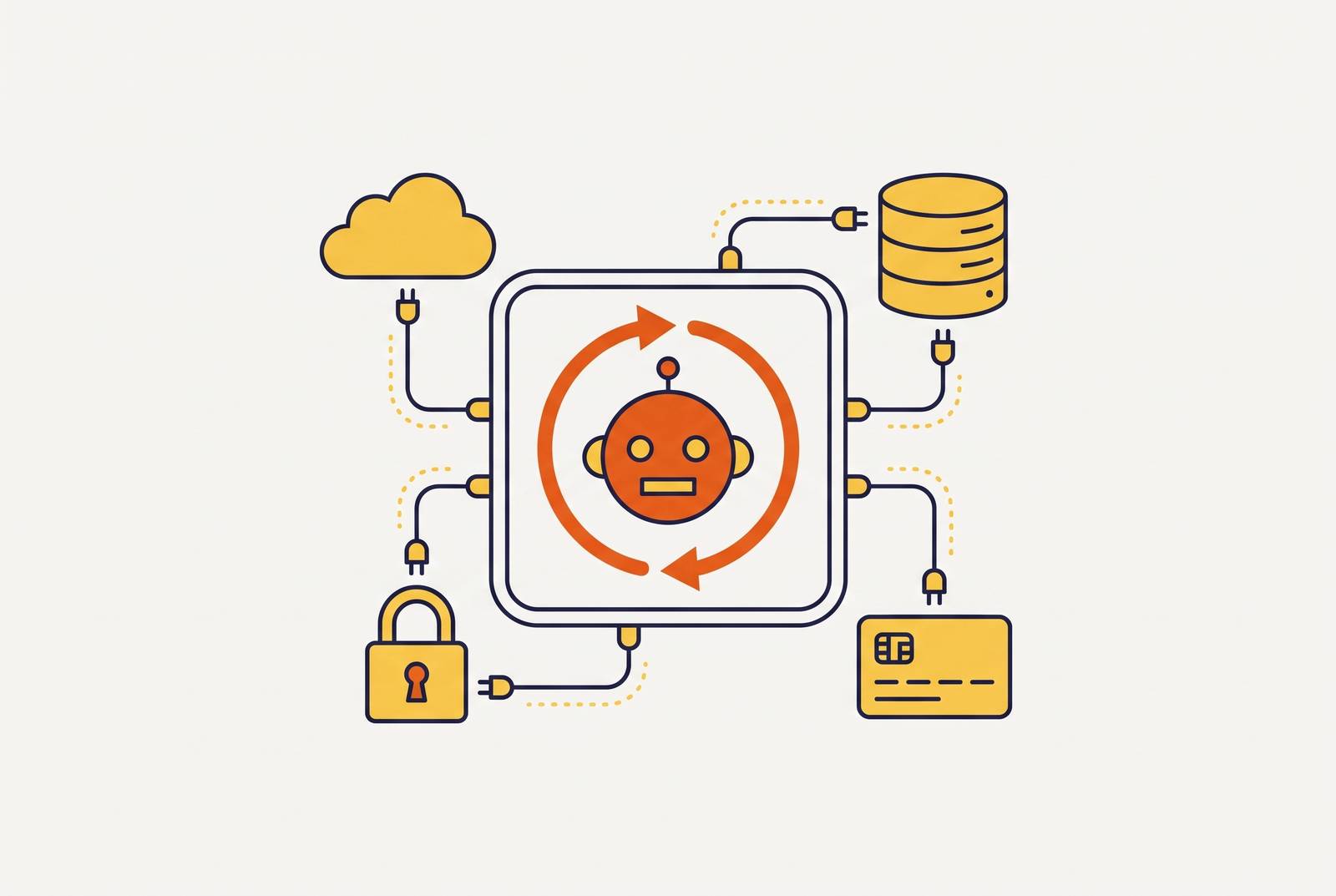
Tools for RL environments that call third-party APIs need stateful, deterministic simulators. A custom training environment must let agents change resources, see what happens, and replay sequences across parallel rollouts that are kept apart. The architecture pairs those simulators with tool interfaces shaped like those in production, rewards based on state, fault injection, and checks against the real APIs.
Why RL agents that call APIs need a different kind of environment than RL agents that play games
A game or physics environment owns the state its agent changes. It can reset that state cleanly between episodes. An agent calling Stripe, GitHub, or Slack instead acts on resources outside the training process, where each valid response depends on earlier actions. Creating an invoice changes what a later retrieval should return. The environment therefore needs to model the consequences of calls.
Static evaluation misses that chain of consequences. AgenticAI-Supervisor, from Uber AI Solutions in 2026, argues that traditional static evaluation cannot capture multi-step decision-making because it provides no environmental feedback across turns. It reports that enterprise-grade models fail approximately 76 percent of complex professional tasks due to compounding execution errors. Long API workflows bring out this weakness because an early mistake changes what every later decision must take into account. Standard tooling does not supply the resource semantics of third-party APIs.
Why live endpoints and stateless mocks both fail as the environment substrate
Live endpoints preserve real behavior but surrender control over execution. Rate limits restrict parallelism, network failures disrupt runs, and credentials introduce exposure that an isolated environment avoids. An agent creating thousands of Stripe invoices creates thousands of records, while the provider determines how quickly those calls can proceed. Repeating an action sequence may also produce different observations, making failures harder to reproduce.
Stateless mocks remove those operational constraints but discard causality. A canned creation response does not make the resource appear in a later list response. The scenario author must write both outputs consistently, then maintain that consistency for every possible trajectory. A valid but unanticipated action can therefore leave the agent observing an impossible world. Across thousands of rollouts, manually scripted responses cannot cover the branching sequences that exploration produces.
These alternatives fail for different structural reasons. A training substrate must run under local control and base its responses on mutable state that holds all the changes made so far. It must remember what the agent changed while remaining disposable between episodes.
What a stateful API simulator actually does inside a training loop
A stateful API simulator is a locally hosted service backed by an in-memory or ephemeral database of resources. Creation, retrieval, update, and deletion operate on the same state within a session. Once a resource is created, later reads can see it. Updating it changes later observations, while deleting it removes it from the relevant results. The simulator computes responses from the world the agent has produced.
That world persists within an episode, then resets to a known baseline. Pre-seeded records give the agent realistic starting conditions instead of an empty sandbox dominated by unsuccessful lookups. Fault injection adds controlled latency, 429s, 503s, or malformed responses at specified call positions or probabilistically. Each rollout remains isolated from every other rollout. The same scenario and controlled fault conditions provide the basis for replay without contamination from concurrent agents.
AgenticAI-Supervisor formalizes this need for thousands of parallel, isolated trajectories inside secure sandboxes. Isolation is a correctness requirement. However, internal consistency alone does not establish fidelity to production. Verification against the real API before each simulator release is needed to distinguish a faithful implementation from a coherent but inaccurate model.
What tools for RL environments need in an API training architecture
The architecture connects rollout workers, simulator instances, scenario fixtures, and the agent’s production tool interface. Each worker gets its own simulator instance and loads a named scenario before it starts. For example, a Stripe scenario might contain two existing customers, one open invoice, and one failed charge. Calls then change only that instance’s resources. At episode end, the environment resets to its baseline or loads a fresh scenario seed.
AgenticAI-Supervisor uses a dual-phase framework that reflects that separation, allowing environment scaffolding to be prepared apart from high-concurrency execution. Versioned scenario libraries make those starting conditions reusable across training and regression runs. Reset speed also affects total throughput. A fast policy saves little time if every episode has to wait for its environment to be ready again.
The tool interface must use the same calling conventions as production. Definitions should match the real API’s schema, with simulator endpoints substituted without an agent-visible simulation-mode wrapper. For parallel execution, lightweight local processes or containers provide one instance per rollout worker, while orchestration manages their lifecycle. Modal’s sandbox infrastructure illustrates relevant properties, including sub-second consistent starts at high concurrency and automatic CPU and memory bursting. Those properties support throughput, but the architectural invariant remains separate state for every concurrent trajectory.
Designing reward functions that read simulator state rather than agent text
A reward based on the agent’s final explanation measures what it says happened. A state-based reward measures what actually changed. Stripe’s 2026 agent benchmark documented agents passing nonexistent Stripe data, observing errors, and considering the task complete. A plausible completion message cannot establish that those actions succeeded. The reward function needs evidence independent of the agent’s account.
After an episode, the evaluator can query the simulator directly to check that an invoice exists, that its status is “paid,” or that a customer record has the correct email. These assertions tie completion to resource state. The same inspection can identify spurious records created along the way. AgenticAI-Supervisor uses strict internal state validation and trajectory-efficiency signals to mitigate reward hacking rather than relying on surface-level textual heuristics.
Correctness, call efficiency, unwanted side effects, and fault recovery are separable reward dimensions. An agent reaching the correct final state in three calls should score higher on efficiency than one taking twelve. Yet state-based scoring does not make exploitation impossible. An agent can still discover a simulator bug that permits an invalid route to a rewarded state. Verification against real API behavior is therefore part of reward correctness.
Fault injection as a training input, not a post-hoc stress test
Reaching the right final state when everything works says little about how an agent recovers when a tool fails halfway through a task. Across a long workflow, unhandled errors can compound. Fault injection belongs in training so agents get feedback on how they recover before deployment, as well as in a final resilience test. An agent that correctly retries a 429 and finishes should score higher than one that aborts.
Not every damaging fault announces itself with an error status. A normal HTTP 200 can contain a missing field or an incorrect payload. AgentChaos describes how omission faults bypass error handling because they return valid HTTP 200 responses. It also found simpler ReAct agents more resilient than Reflexion agents, whose self-reflection mechanism amplified fault impacts.
Stateful simulators can compose failures across services within one episode. A schedule might inject a 429 on the third Stripe call, a 503 on the first GitHub call, and a latency spike on Slack. These combinations expose interactions that single-fault tests miss. Injection belongs at the simulator layer so the agent experiences ordinary tool responses without a special testing signal. A held-out fault configuration then tests whether recovery generalizes beyond the schedules encountered during training.
Matching simulators to the APIs your agent actually calls
Simulator selection begins with the resources an agent must manipulate. Payment APIs such as Stripe and PayPal need financial state transitions that match the real service, while Slack needs state for its channels and threads. GitHub needs repository and PR state, and Kalshi needs order-book state. These are different modeling obligations. A broad endpoint catalog is useful only where its supported operations preserve the dependencies the workflow exercises.
An agent that opens a GitHub PR, posts a Slack notification, and creates a Stripe invoice needs all three simulators active, with each maintaining its own state inside the rollout. The public scalable-agentic-system study on GitHub tested an agent across PayPal, Stripe, Slack, and Twilio simultaneously, including 112 PayPal operations. Overlapping schemas make tool disambiguation a practical retrieval problem at that scale. Selection must therefore account for the full tool surface.
Published match rates against live API behavior provide an objective signal, while realistic seeded data exercises more than empty-resource responses. A simulator should support the state transitions relevant to the task. Release-by-release verification then tests the dependability of that initial fit as the provider changes.
Keeping the simulator honest as the real APIs change
Providers can add fields that calls must include, change validation rules, deprecate enum values, and change the shape of error responses. Such changes do not necessarily arrive with breaking-change notices. A simulator can therefore remain internally consistent while becoming inaccurate. Its own tests and the agent’s evaluations may both stay green because both depend on the same outdated assumptions. Neither result demonstrates agreement with the provider.
The structural remedy is a release gate against the live API. Every endpoint the simulator claims to support must undergo verification against current provider behavior before a new version ships. Published fidelity scores make the extent of that agreement visible, so training teams can plan around known limitations. Without verification, those limitations remain unknown. A passing local suite cannot replace that external reference.
When verification detects drift, the remediation sequence is to update the simulator, re-verify it, re-seed scenarios, and optionally rerun affected training episodes. For RL, the consequence of neglect is deeper than an inaccurate test result. The training loop incorporates the simulator’s incorrect feedback into the policy, reinforcing behavior that may fail only when evaluated against the real service or deployed.
Putting the loop together with a concrete wiring sequence from environment setup to trained policy
To implement this architecture, begin by confirming the simulator version’s published fidelity score against the target APIs. Do not start training on an unverified simulator. Record its version and verification date in the run metadata so the environment’s provenance remains attached to the resulting policy.
Next, give scenario fixtures names and versions, and fill them with realistic records, balances, or open orders. Include empty and populated states, plus relevant edge cases such as a resource at its limit or a recently deleted record. Keep scenario versions aligned with simulator versions. An API change can invalidate a previously useful starting condition.
Expose each simulator as an HTTP service on a known local port, then point the agent’s tool definitions to that address. Preserve the production interface without a simulation-mode flag. Log every tool call and response as part of the trajectory record for debugging and reward computation.
Configure fault schedules before launching the rollout fleet. Specify endpoints, fault types, frequencies, and call indices, including both combinations and isolated failures. Reserve a fault configuration for held-out evaluation.
Spawn one simulator instance per rollout worker, using container-per-instance isolation and enforcing the mapping in orchestration. Keep workers from sharing or seeing each other’s simulator state. Measure cold-start time as part of environment benchmarking. Instance startup and reset must support the intended rollout throughput.
At episode end, query the simulator’s state API to evaluate the scenario’s success assertions. Give separate scores for correctness, efficiency, unwanted mutations, and fault recovery. The trajectory log provides the accompanying record of how the agent reached the final state.
Before the next training cycle, check the simulator against the real API again. If drift appears, update and re-verify the simulator, review affected scenarios, and document the change before resuming. Keep a training registry that lists the simulator version, scenario library version, fault configuration, and reward function version. Together, those records define the environment that shaped the policy.