Horizontal Scaling Strategies for Automated AI Agent Eval Pipelines
Scale agent evals with isolated, stateful simulators that reset cleanly.
To use an API for agent evals at scale, run each worker against an isolated, stateful simulator with realistic data, a reproducible starting state, and fidelity tested against the live API. Evaluate the agent’s full trajectory and resulting world state, including recovery from injected failures. Horizontal scaling becomes trustworthy only when the environment preserves cause and effect within each rollout without introducing uncontrolled differences between workers.
Why horizontal scaling breaks for AI agent evals when the environment isn't deterministic
Two workers run the same agent task and return different results. One succeeds while the other fails after a tool call. Against a changing backend, that disagreement cannot reliably distinguish a capability gap from an environment artifact. Adding workers multiplies the ambiguity.
Towards More Standardized AI Evaluation: From Models to Agents by El Filali & Bedar, 2026, argues that intermittent failure can make a system unacceptable even when its average score looks strong. Variability is itself part of the evaluation signal. Yet live APIs introduce changing data, rate limits, and latency variance that obscure its source. Stateless mocks remove some external variability but return canned responses regardless of earlier actions. Traditional tooling built around stateless model outputs therefore cannot become a sound agent harness simply by distributing more tasks across workers.
What agents actually need evaluated: trajectories and world state, not individual tool calls
The Evaluation Context Protocol (ECP): A Portable Contract for AI Agent Evaluation defines the trajectory as “the end-to-end sequence of internal reasoning, tool calls, and environmental observations”. A wrong intermediate step can corrupt data, trigger an unauthorized transaction, or cascade into later steps even when the final answer appears correct. The final response is not sufficient evidence. Tool-call accuracy establishes whether the agent chose the right tool and arguments, but it cannot establish that the whole workflow behaved correctly.
An agent can make the expected calls and still leave corrupted state, while an unexpected but valid path may produce the right outcome. Evaluation must therefore check both the sequence and the effects its steps have together. That requires writes to persist and become visible to subsequent reads. The standardization paper treats execution context as part of the system being measured, so a backend that breaks this causal relationship changes the subject of the test.
How the eval pipeline itself is structured for scale: sharding, parallelism, and selective re-evaluation
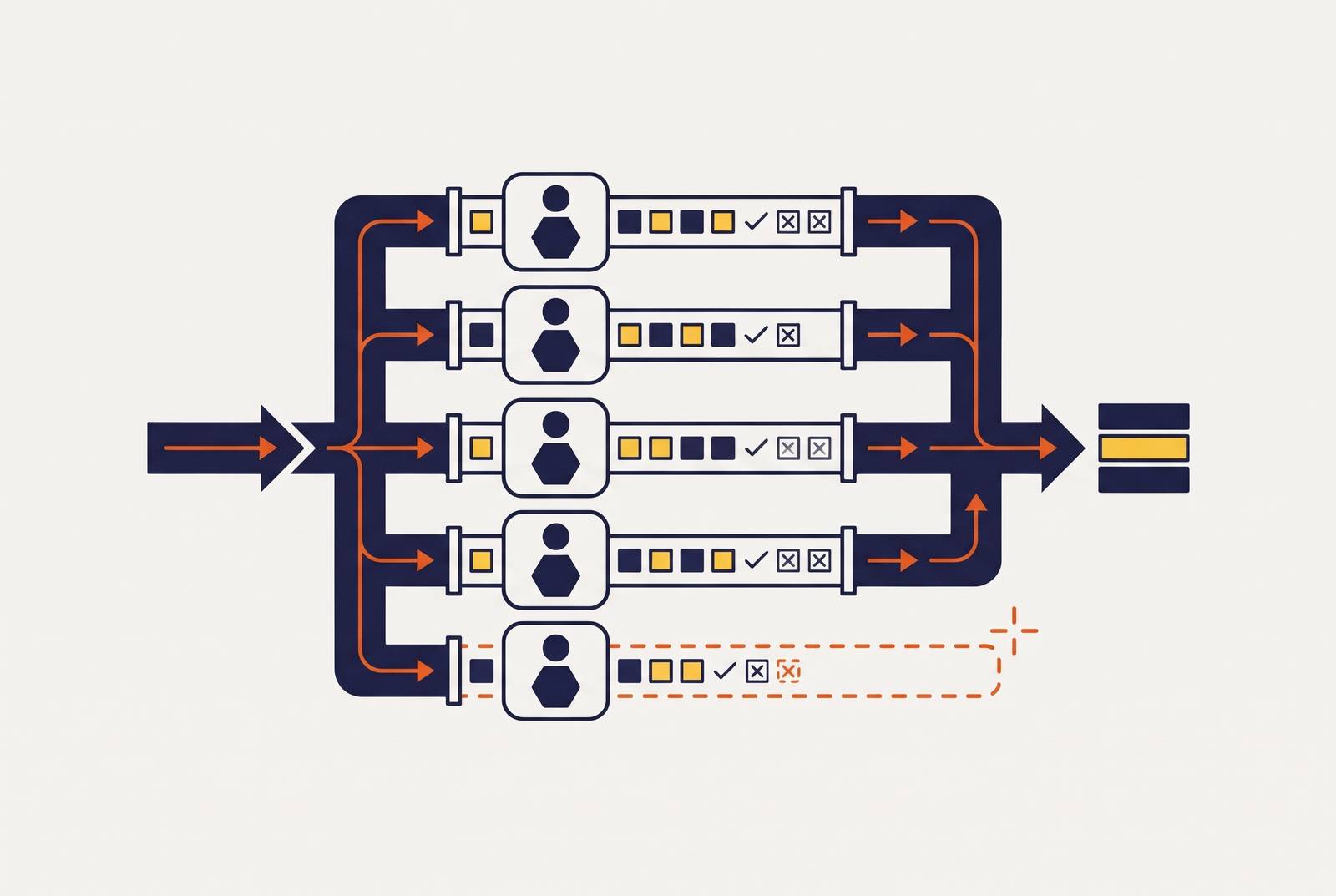
The GenAI Evaluation pipeline, built at Lowe’s on Kubeflow Pipelines, provides a concrete model for distributing evaluation work. It reads logs, normalizes and shards records, applies asynchronous multi-dimensional scoring, and produces traceable outputs with per-record provenance. Modular, containerized stages distribute the workload across workers. Shard-level failure isolation prevents an incomplete portion of the workload from requiring wholesale recomputation. This architecture supplies the mechanical foundation for scale, although agent evaluation also needs a reproducible environment for each rollout.
The pipeline identifies incomplete or malformed records and regenerates only those. Schema locking, versioned configurations, deterministic output streaming, and validation logs make parallel outputs comparable and auditable. The same pipeline achieved a macro F1 of 0.93 on classification tasks. That result supports the value of governed evaluation, but it does not establish correctness for state-changing agent workflows.
For agents, the cadence must also reflect different operational needs. Fast behavioral checks on every PR catch tool-use regressions, nightly suites assess broader quality, and continuous production monitoring detects drift from the evaluation baseline. Reasoning quality belongs in experiment workflows as well. The standardization paper treats evaluation as an ongoing process across inputs, environments, and execution contexts, so the architecture must make reruns sustainable from the start.
Why agent topology — parallel workers versus hierarchical role structures — changes what the environment must handle
More evaluation workers and more agents inside a workflow create different scaling problems. Parallel ensembling is the simpler case because agents perform the same task and their results are aggregated. Each run being evaluated can have its own isolated environment with the same starting state. Comparisons depend on those initial states genuinely matching. Otherwise, agents may seem to differ because the worlds they worked in were different.
Hierarchical workflows require coordination within a shared world. A planner delegates work to executor agents, whose tool calls mutate state that the planner subsequently reads. The environment must support concurrent, interleaved mutations without introducing race conditions that invalidate the test. Isolation belongs between independent rollouts. As roles and dependencies multiply, environmental demands extend beyond provisioning more independent containers.
The organizational analogy is useful but limited. Coordination mechanisms need to precede additional headcount, just as shared-state rules need to precede more complex agent configurations. Distributing independent evaluations is primarily an infrastructure problem. Evaluating coordinated workflows also requires environment design, because the interactions among agents become part of what the harness must preserve and expose.
What the environment must provide: stateful, resettable, isolated instances at every rollout
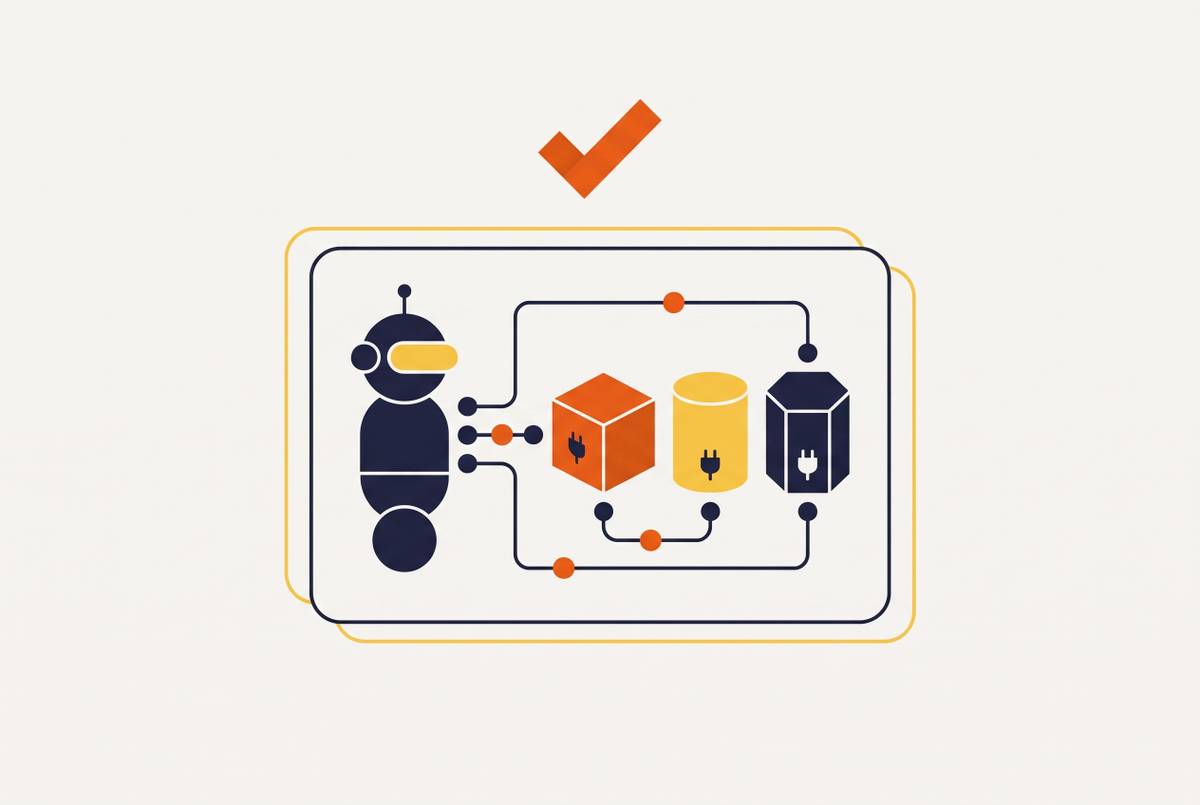
The resulting prescription is precise. Each worker needs an environment that is stateful within a rollout, isolated from other workers, and resettable to a known baseline between rollouts. Persistence lets later reads reflect earlier writes. Isolation keeps changes in one evaluation from affecting the conditions of another, while resetability lets runs be compared on the same terms. A shared sandbox cannot provide worker-level isolation merely because it is separate from production.
The standardization paper identifies environment setup and tool contracts as first-class evaluation concerns. A known starting state helps separate a broken harness from an agent’s inability to complete the task. For reinforcement learning, that distinction also governs reward quality. When each rollout begins from the same baseline, rewards can reflect agent behavior under controlled environmental conditions.
A reproducible baseline still needs a realistic world. Existing orders, open issues, pending payments, and prior messages give the agent objects and relationships to reason about or corrupt. An empty namespace omits those conditions. Pre-seeded data therefore supplies more than convenient test fixtures because it establishes the context in which correct actions and harmful side effects become distinguishable. The final-state check is useful only when the initial state exercises the intended workflow.
Fault injection as a first-class eval dimension, not an afterthought
An agent can pass every ordinary transactional test and still execute a side effect twice after a timeout. The dangerous case is a write that succeeds before its confirmation is lost, followed by a retry that repeats the action. A canned timeout response cannot show what happened. The backend must remember the first write and fail at a specified point so that evaluation can expose the consequence of the retry.
Resilience tests therefore need fault injection that can be controlled and repeated. Configurable rate limits test whether an agent backs off when a call is rejected, while a realistic 401 error envelope or a token that expires mid-sequence tests how it handles authentication recovery without live credentials. Other scenarios include dropped connections, delayed chunked responses, stream truncation mid-flight, out-of-order webhook delivery, token timeouts, and late event retries. These conditions must occur at chosen points in the workflow, even when they would only happen from time to time during a run.
Fault tests should run in the same stateful environment that behavioral tests use. A separate mock layer can sever the relationship between the fault and the state that preceded it. Live APIs present the opposite problem because their failures are consequential but cannot be summoned reproducibly at the required step. Testing recovery requires both control over the failure and a world that retains its effects.
How can you test your AI agent against realistic API responses without hitting production?
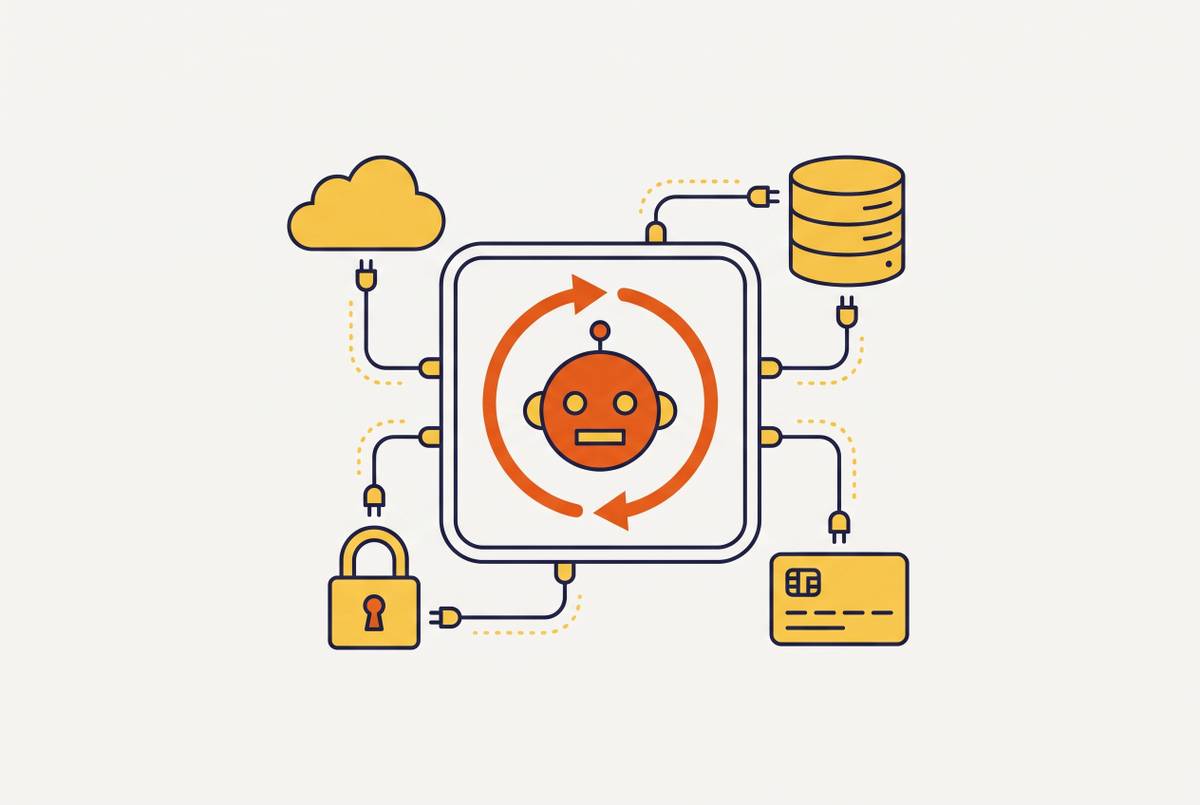
A backend that meets these requirements must preserve state, reproduce starting conditions, isolate workers, and inject faults without touching live services. A stateful simulator supplies that combination when it includes realistic pre-seeded data and verification against the real API. Its role follows from the evaluation requirements. It is not simply a faster substitute for making live requests.
Live APIs provide real behavior but also changing data, real rate limits, and credential requirements that complicate CI. They cannot reliably reproduce a chosen failure at a chosen step. Stateless mocks offer controlled responses but cannot expose bugs in which earlier writes corrupt later reads. Record-and-replay approaches preserve historical responses, yet those recordings do not establish how the API behaves now. Each alternative leaves a different part of the evaluation contract unsupported.
Stateful simulators for APIs like Slack, GitHub, Stripe, Kalshi, and PayPal can run locally or in CI containers. Giving each worker an isolated instance lets more workers run without sharing mutations, while a known pre-seeded state lets rollouts be repeated. Realistic responses then follow from a persistent world. Continuous fidelity verification is still necessary, however, because internal consistency alone does not prove that the simulated world matches the API the agent will encounter.
Fidelity drift: why a simulator that isn't continuously verified against the live API will silently mislead evals over time
Third-party APIs change response schemas, rate-limit policies, fields, and error envelopes on their own schedules. A simulator can therefore remain deterministic while becoming inaccurate. This is the strongest objection to simulation. An agent may pass every local evaluation and then fail against a schema change that the simulator never incorporated.
Before every simulator release, fidelity should be tested against the real API, and published scores should show how closely each endpoint matches the way it behaves now. Those scores make discrepancies visible and auditable. Teams can set thresholds and treat a fidelity drop as a CI failure instead of discovering the gap through an agent’s production failure.
The standardization paper warns that evaluation pipelines can themselves introduce silent failures. Recorded cassettes and hand-authored mocks can also become stale, but neither approach inherently provides a verification mechanism. Treating fidelity as an engineering discipline makes the harness testable, although it does not remove the need to respond when verification reveals a gap.
Assembling a working horizontal eval pipeline: the practical configuration from PR check to nightly regression
Each parallel worker should launch its own containerized simulator with a seed state that is known and realistic. Between rollouts, the instance should be torn down and replaced. Collaborating agents within a rollout should use the same world, while independent shards remain isolated from one another.
At PR level, fast behavioral tests should run on every commit against that stateful environment. They should check tool selection, call sequence, and final world state, because correct JSON alone is too little to go on. Nightly regression suites should expand coverage to multi-step workflows and configured fault cases, including 429 backoff, timeout retry, and authentication failure. Production monitoring completes the cadence by detecting departures from the evaluation baseline.
A fidelity gate should precede simulator updates to the fleet. The update must meet the team’s threshold against the live API, and a fidelity drop should fail the pipeline. Following the GenAI Evaluation model, an invalid or incomplete shard caused by a transient environment issue should be rerun without recomputing the full suite. That exception must be kept separate from a real drop in capability or resilience.
The ECP paper proposes a portable evaluation contract using a JSON-RPC interface that exposes user-visible output, tool calls, and evaluator-safe audit context. This abstraction separates the agent from the harness. It can support a pipeline that uses multiple simulator backends or changes them as API coverage expands, without binding the evaluation contract to one environment implementation.
For teams running reinforcement learning, the same simulator fleet can serve training rollouts. The container model, seeded state, isolation, and controlled world dynamics already give evaluation and learning what both need from an environment. Thousands of parallel rollouts need that foundation rather than a separate collection of live-service dependencies. Determinism makes scale useful because it lets both evaluation results and reward signals remain attributable to agent behavior.
Sources
- Operationalising Multi-Dimensional Evaluation for Conversational Agents: A Scalable, Governed Pipeline with Selective Re-evaluation and Model Benchmarking
- Towards More Standardized AI Evaluation: From Models to Agents
- The Evaluation Context Protocol (ECP): A Portable Contract for AI Agent Evaluation
- Reliable agent engineering should integrate machine-compatible organizational principles
- Grounded Scaling: Why Agentic AI Needs Deterministic Environments