Running a Fully Controllable API Simulator in Your Local Dev Loop
Local stateful simulators let you test create-update-read sequences without touching real APIs.
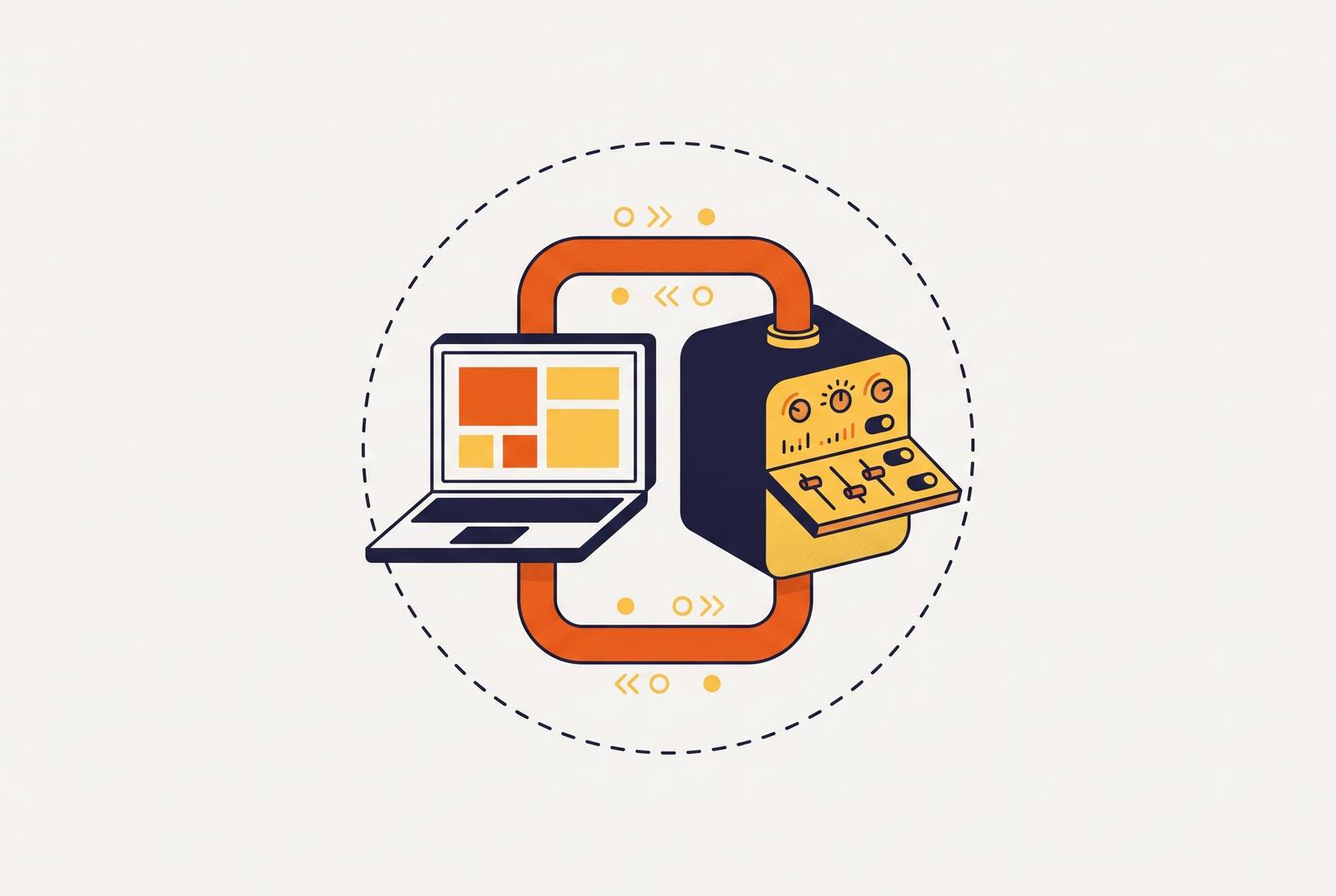
Integration testing against stateful APIs requires a local simulator that preserves resources, enforces lifecycle transitions, and connects asynchronous events to the calls that caused them. Running a fully controllable API simulator in your local dev loop makes create, poll, update, and conflict sequences repeatable without touching a real endpoint. It complements unit tests and live environments.
Why stateless mocks cannot model a multi-step API interaction
A newly created item appears in the UI, then vanishes when TanStack Query or SWR invalidates the cache and refetches the list. The mock returns its original seed data. It has no memory of the create call, so the developer ends up adding client-side workarounds for behavior a real backend provides automatically. The defect lies in the test environment.
A create response can return an ID unrelated to the next read response, while a polling loop either finishes immediately or never terminates. A conflict that should return 409 because a resource already completed is unreachable unless separately configured. Those responses cannot establish that the application followed a valid sequence.
The useful distinction is between static, conditional, stateful, and scripted behavior. Static tools return one response per route, while conditional tools vary responses by request shape without persisting changes. Stateful tools keep data from one request to the next, so resources that have been created can be listed and deleted. Scripted tools let each request run any logic, but can turn into a second backend implementation that nobody keeps up to date. Stateless tools still suit narrower jobs, including isolating a function from the network, checking headers, or stubbing a dependency without a public specification.
What "stateful" actually means in practice, and what it demands from a simulator
The diagnostic sequence is create, read-back, mutate, and read-back again. For a payment API, a test creates a payment, reads its pending status, submits a capture, and reads it again. A stateful simulator returns “captured” on that final read because the preceding call changed the resource.
A resource lifecycle also constrains which changes are possible. In the lifecycle described here, a payment cannot move from “requires_payment_method” to “succeeded” without passing through “processing”. A state machine enforces that progression and prevents tests from succeeding through transitions the real API would reject.
Asynchronous behavior must follow the same causal chain. Webhook events should fire when a state transition occurs, rather than on a hardcoded schedule unrelated to the test. Keeping environments separate matters just as much because test data must stay out of production analytics and must not trigger real-world side effects. A physically separate simulator provides that boundary, whereas a test-mode flag on shared infrastructure does not establish it by itself.
Three local simulators that meet the stateful bar, and what each one actually covers
LocalStripe, the open-source SebasRaul2503/localstripe project, runs through Docker Compose and covers customers, payment methods, payment intents, Checkout Sessions, refunds, events, and signed webhooks. Its state machine enforces the payment lifecycle from “requires_payment_method” to “succeeded” or “canceled”. Test cards make outcomes deterministic. They select success, decline with a decline code, 3D Secure, or asynchronous processing, while other card numbers are rejected. Official Stripe SDKs work against it by changing the host.
Slack Simulator, the open-source ClydeDz/slack-simulator project, provides a browser-based local Slack workspace and platform APIs. It supports end-to-end app and bot testing without installation into a real workspace. Mock users can be switched during a test. That enables approval-flow and permission testing, with visibility into Events and Interactivity payloads, Web API calls, and raw SQLite database state.
Emulate provides local, stateful replacements for Stripe, GitHub, Google, AWS, and 7 more services for development and CI. It needs no API keys or network connection, and the SDKs already in use work without code changes. Its protocol coverage includes OAuth flows with RS256 ID tokens, AWS XML responses, and Slack cursor pagination. Seed data saves the work of setting up an empty sandbox at the start. That data includes Slack channels and a large open-source GitHub repository, giving tests an existing environment to query and modify.
These options differ in coverage. LocalStripe concentrates on payment behavior, while Slack Simulator exposes workspace interactions and their underlying state. Emulate spans multiple service APIs and protocols. Choosing a simulator means checking that it has the lifecycle, event behavior, and SDK compatibility the integration needs, as well as state persistence.
Wiring a stateful simulator into the local dev loop without changing application code
The practical setup begins by starting the simulator as a Docker container or local process before running the application’s tests. The application and simulator then run side by side. Next, point the API client at the simulator through the application’s existing configuration or an SDK base-URL override. Finally, run the existing integration test against that local endpoint, using the same SDK operations as those used against the provider.
The configuration distinction is important for this step. An environment variable works only when the application already reads it and passes its value to the SDK. Stripe’s Java SDK exposes Stripe.overrideApiBase() for base-URL configuration, while STRIPE_API_BASE is not an official Stripe environment variable. The intended change is endpoint configuration.
With that override in place, the existing test can create a resource and read its changed state through the normal client. No live credentials belong in this local configuration. A structurally valid placeholder is sufficient for a simulator that accepts such keys, without provider billing or quotas. Where seeded service data is available, the first test can list channels or exercise supported subscription behavior without first constructing an empty environment.
Resetting simulator state between test runs without restarting the server
Once the simulator is running, reset its state before each independent test through POST /reset or an equivalent endpoint. The reset should restore the pre-seeded baseline in one call. Put it in beforeEach or use fixture teardown to establish the boundary between tests. Restarting the server for every test is too slow for a tight development loop.
Without a reset, a resource created in one run remains present in the next, so a later test’s result can depend on execution order. After a reset call, that later test begins from the baseline. State still persists within the sequence under test.
For concurrent tests, session isolation offers an alternative. Writes enter a session-scoped overlay, reads merge that overlay with shared seed data, and the overlay is discarded when the session ends. This avoids an explicit reset and prevents concurrent sessions from interfering. Either approach also prevents a long-lived team environment from accumulating weeks of unrelated test data.
Running the same stateful simulator in CI without rate limits or live credentials
The CI setup builds on the local container pattern and adds parallel builds, merge gates, and reports that are kept after the run. Each build needs isolated state rather than a shared environment that other jobs can mutate or reset. Running these integration tests against the simulator removes the rate-limit collisions caused by concurrent runs sharing live credentials, while preserving the resource sequences the tests need to exercise.
The recommended pipeline orders its gates by feedback speed. Unit and contract tests run at pre-commit, integration tests that use the simulator run at PR, full regression runs post-merge, and synthetic monitors run post-deployment. Place the simulator integration stage after build and before deployment, and keep it distinct from unit tests so failures are attributable. Gate merges to main on its results.
Invoke the test runner through its CLI and inject no live secrets, using a structurally valid placeholder where needed. Publish JUnit XML or SARIF reports as build artifacts and fail the build on any non-quarantined failure. Offline CI adds another constraint to this setup. In an air-gapped environment, tests cannot reach a third-party API, so the stateful simulator gives them the local API layer they need to test multi-step interactions.
Injecting faults to test how the application behaves when the API misbehaves
A 503 after a lengthy timeout, a 429 mid-checkout, or a missing webhook can expose the failure path behind a production incident. A live provider cannot make those conditions happen on demand. A stateless fixture can return an error, but cannot connect it faithfully to the evolving resource lifecycle. Controlled fault injection ties a failure to when it happens and the state at that point.
LocalStripe can add artificial delays globally, per scenario, per card, or per request without blocking the server. That granularity keeps a targeted checkout test from slowing every unrelated operation. It also permits the application’s waiting behavior to be tested while the simulator remains responsive.
A fault schedule governs timing, frequency, and intensity so the same configuration can be exercised across runs. Mock network interfaces can also delay response transmission or induce protocol errors to test recovery. The objective is repeatability. Unit tests can check error-handling branches on their own, but the stateful sequence shows whether recovery works after earlier calls have already changed the resource. Those failure paths, once hard to test, can then run as part of routine CI.
Using the same stateful simulator to test AI agents that call external APIs
An AI agent using payment or messaging tools faces the same resource constraints as a human-authored integration. It creates records, reads them back, and encounters conflicts. Coherent language does not prove valid API behavior. An agent can describe a successful action while generating malformed JSON or misinterpreting a failed tool response.
For that reason, agent integration tests should run the full agent against its actual tool implementations in a staging environment, with external API calls directed to the simulator. The LLM should not be mocked out of that test. The purpose is to expose failures that arise between components, including changed response schemas, timeouts, and empty query results. Assertions need to cover parameter extraction, endpoint selection, and response parsing rather than accepting a valid fixture as proof of a valid interaction.
Tool access also introduces authorization risks beyond read-only language generation. Prompt injection can try to make unauthorized API calls, extract data, or change records, so the simulator must enforce authorization constraints and reject requests that break them. A 429 or malformed response can reveal whether the agent retries correctly or reports success despite a failed call, using the infrastructure already established for ordinary integration tests.
How simulator fidelity is measured and what happens when it drifts
A local simulator loses value when its behavior diverges silently from the live API. Tests can pass against responses the provider no longer returns, leaving production to expose the gap. Mocks kept up to date by hand are especially prone to this drift because someone must update them each time the provider changes. Spec-derived tools reduce that burden, but their accuracy remains bounded by the OpenAPI document from which they are generated.
Continuous verification should compare the simulator with the real API on a cadence, examining responses field by field. A published fidelity percentage needs a probe count so readers can judge how much of the API surface was exercised. Fidelity is not a binary property of a product. A score without coverage context cannot establish that the lifecycle used by a particular integration was tested.
These comparisons are separate from the offline development loop. These comparisons check whether the local simulator can still be trusted before developers build against its behavior. When drift reaches production, confidence in the platform suffers, and restoring it requires a public score or a reproducible verification method. Before adopting any simulator, ask for its fidelity score and verification methodology. If neither exists, adoption depends on somebody’s memory, which is precisely the dependency that hand-written mocks were supposed to leave behind.